
Or Decide Who Deserves Help First?
We like the phrase “look for the helpers.”
It feels safe. Reassuring. Not overtly political.
The quote , which was popularized by Fred Rogers, gets shared every time something terrible happens. Hurricanes. Shootings. Fires. Mass violence. It’s our way of saying, “Yes, the world is broken, but there are still good people out there.”
And that’s true.
But here’s the problem: we’ve turned “look for the helpers” into a way of staying emotionally comforted without ever asking whether we’re willing to be one.
Jesus doesn’t treat helping as a comforting idea.
He treats it as a dividing line.
In Matthew 25, Jesus doesn’t ask people what they believed, how often they prayed, or whether they got the theology right. He asks painfully simple questions:
Did you feed the hungry?
Did you welcome the stranger?
Did you care for the sick?
Did you visit the imprisoned?
Not did you feel bad.
Not did you post about it.
Not did you argue about it online.
Did you help?
And this is where American culture and too often, American Christianity gets uncomfortable.
We Live in an Age of Outrage, Not Mercy
Our cultural reflex right now isn’t compassion.
It’s outrage.
Outrage gets clicks.
Outrage keeps us scrolling.
Outrage gives us someone to blame.
We are constantly being trained to ask, “Whose fault is this?” instead of “Who needs help?”
Even worse, outrage lets us sort people into categories:
- Deserving
- Undeserving
- “One of us”
- “Not our problem”
And the church hasn’t been immune to this. In many cases, we’ve annointed it.
We say things like:
- “That’s terrible, but they made their choices.”
- “I feel bad, but helping them would just enable bad behavior.”
- “That’s sad, but the system should handle it.”
Jesus doesn’t give us that way out.
In Matthew 25, Jesus identifies himself entirely with the people we are most tempted to dismiss:
- the hungry
- the stranger
- the sick
- the imprisoned
Not the powerful.
Not the perfect.
Not the ones just like us.
He says, “Whatever you did—or didn’t do—for them, you did—or didn’t do—for me.”
That’s pretty straightforward.
Helping Isn’t Neutral.
One reason we avoid helping is that it complicates our certainty.
Helping interrupts schedules.
It messes with budgets.
It forces us to listen to stories that don’t fit our political or theological boxes.
Helping requires proximity. And proximity has a way of wrecking long-held opinions.
It’s much easier to argue about people than to sit with them.
That’s why Jesus doesn’t praise good intentions in Matthew 25.
He praises embodied mercy.
And he condemns something far more familiar to church folks than cruelty:
Neglect.
The people Jesus condemns aren’t violent.
They’re indifferent.
They didn’t harm anyone.
They just didn’t help.
That should make every comfortable Christian uneasy.
Let’s Talk About ICE (Because Jesus Would)
If faith is meant to have anything to say about real life, then it has to say something about what’s happening right now.
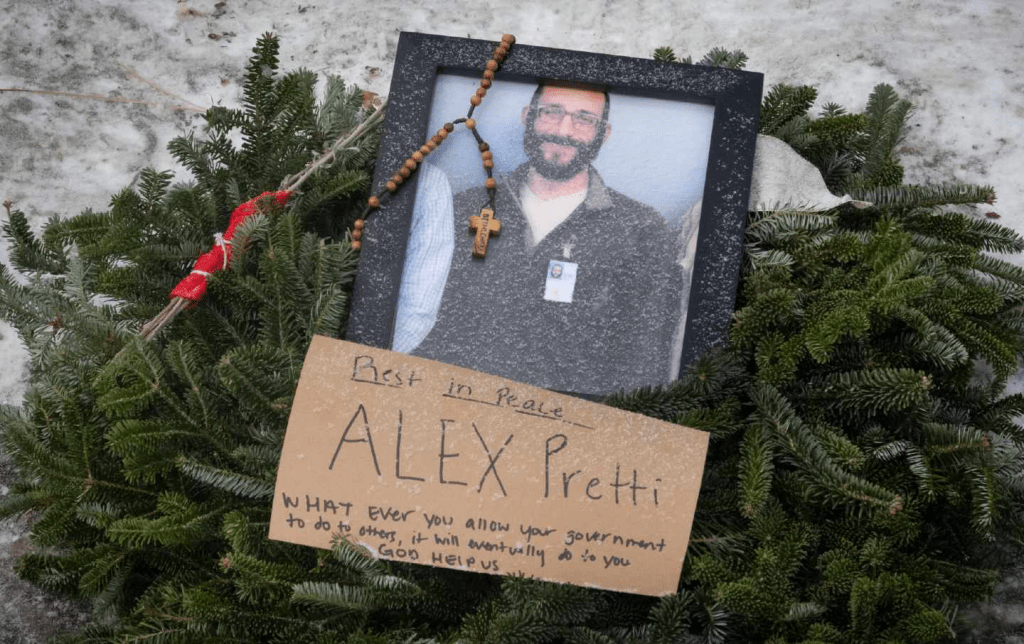
Last week, a man named Alex Pretti—an ICU nurse who worked with veterans—was killed during an immigration enforcement operation in Minneapolis. He was trying to help someone. Witnesses describe attempts at de-escalation. What followed was pepper spray, physical force, and fatal gunfire by federal agents associated with U.S. Immigration and Customs Enforcement.
This isn’t a hypothetical moral debate.
This is a human being who spent his life caring for others and died in a moment defined by fear and force.
And here’s the uncomfortable part:
Many Christians rushed to justification.
We argued procedures.
We debated legality.
We asked whether he “should have been there.”
But Jesus never asks those questions in Matthew 25.
He doesn’t ask whether helping was wise.
He doesn’t ask whether someone followed the right protocol.
He doesn’t ask whether the victim fits our political framework.
He asks whether someone was hungry, hurting, imprisoned, or vulnerable—and whether anyone showed up.
When the church becomes more concerned with defending systems than defending people, we have wandered far from Jesus.
The Question Isn’t “Who Deserves Help?”
That’s the wrong question.
The right question—according to Jesus—is this:
Who is in front of you, and will you love them?
American culture trains us to rank worthiness.
Jesus refuses.
American Christianity often tries to soften this teaching, spiritualize it, or delay it until heaven.
Jesus anchors it firmly in the present.
There is no sacred space where this doesn’t apply.
There is no secular space where Jesus isn’t present.
There is just one world.
And in that world, people are hurting.
And Jesus says, “That’s where you’ll find me.”
So What Now?
This isn’t a call to be heroes.
It’s a call to be present.
It’s a refusal to let fear decide who counts as our neighbor.
It’s choosing compassion when outrage would be easier.
It’s helping even when it costs us comfort, certainty, or approval.
Because when we reduce faith to beliefs without action, we don’t end up with deeper spirituality—we end up with indifference dressed up as theology.
And Jesus is very clear about where that leads.
If we’re going to keep saying “look for the helpers,” then we should be honest enough to ask:
Am I willing to be one?
Not just for people who look like me.
Not just for people I agree with.
Not just for people who make me feel safe.
But for the least.
The vulnerable.
The ignored.
The ones Jesus keeps pointing to and saying, “That’s me.”
That’s not comfortable faith.
But it is faithful.
Reflection Question
When you encounter suffering or injustice, do you first ask who deserves help—or do you ask how you are being called to show up?
Closing Prayer
Jesus,
We confess that it is easier to talk about love
than to practice it.
It is easier to argue about systems
than to see the people caught inside them.
Easier to protect our comfort
than to step toward pain.
You tell us that you are found among the hungry,
the stranger, the sick, and the imprisoned—
and too often, we look away because helping feels costly
or complicated
or inconvenient.
Forgive us for the ways fear has shaped our faith.
Forgive us for the moments we chose outrage over mercy,
distance over compassion,
silence over action.
Soften our hearts again.
Not so that we feel better,
but so that we love better.
Give us courage to show up
when it would be easier to scroll past.
Give us wisdom to act with humility.
Give us the resolve to see real people,
not political talking points.
Teach us to recognize you
not only in prayer and worship,
but in the places where suffering lives.
And when love costs us something,
remind us that this is where faith becomes real.
Amen.

 The Rest of the Sermon