
When was the last time your faith actually cost you something?
Not an inconvenience. Not giving up Netflix for Lent so you can feel disciplined and then binge watch it all of April to catch up. I mean something real, a comfort, certainty, reputation, a relationship, a political view. Something you actually valued. Something you actually gave up.
If you’re having trouble coming up with an answer, that’s worth sitting with for a moment.
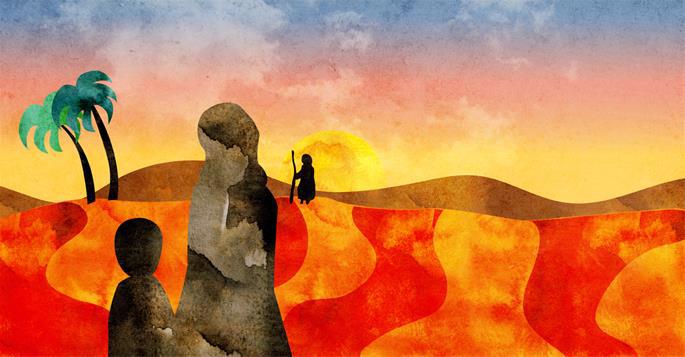
Because the story at the center of this week’s texts is about a 75-year-old man named Abram who, when God said “go,” went. No map. No destination address. Just a direction and a promise.
What Abram Gave Up
We need to understand what Genesis 12 is describing, because we’ve domesticated it into a feel-good story about adventure and faith. It wasn’t feel-good. It was terrifying.
In the ancient Near East, your land was your identity. Your extended family, your “kindred”, was your economic and social safety net. Your father’s house was your entire world of belonging. To leave all of that wasn’t a bold adventure. It was social death. You became a wanderer, which in that culture meant you were legally and socially vulnerable in ways most of us can’t imagine. You had no rights. No one owed you anything. You were nobody.
God was asking Abram to trade everything that made him somebody in order to become nobody, trusting that God would eventually make him into something new.
And the blessing wasn’t just for Abram. “In you all the families of the earth shall be blessed” (Genesis 12:3). The promise wasn’t meant to stop with him. It was a pipeline. God wasn’t blessing Abram so Abram could sit on it. He was blessing Abram so that the whole world would be changed because Abram existed.
And then verse four. Three words. “So Abram went.”
The Church Sat Still
Here’s where we need to get honest, and if you’re not a church person, you’re welcome to nod along because you’ve probably observed this from the outside:
A significant portion of the American church has not been “going” anywhere for a long time. It has been circling the wagons. Protecting its territory. Fighting to maintain its cultural influence. Aligning itself with political power so it can stay relevant while quietly hemorrhaging everything that made it worth being relevant in the first place.
Paul’s argument in Romans 4 is striking precisely because it cuts against religious self-satisfaction. He points back to Abraham and says: the righteousness of the faith-father was never about rule-keeping. It was never about having the right credentials. It was counted to him as righteousness because “Abraham believed God” (Romans 4:3). That’s it. Trust. Not performance. Not institutional membership. Not the right political affiliations.
Paul was writing to a congregation that had gotten very attached to its religious identity — and he was essentially telling them that the founding father of their whole tradition was declared righteous before any of their traditions existed. The foundation was always trust, not performance.
That’s a wakeup call that hasn’t gotten less relevant. In fact, in 2026 America, where “Christian” has become a political identity as much as a spiritual one for many people — where you can clock someone’s theology by their bumper stickers before they open their mouths — Paul’s words land harder than ever.
The question is not whether you attend the right church or vote the right way or have the right opinions. The question is whether you actually trust God enough to move when God says move.
Nicodemus: What It Looks Like to Come in the Dark
In John 3, we meet Nicodemus. He’s a Pharisee. A ruler of the Jews. Educated, respected, established. He has arrived.
And he comes to Jesus at night.
John’s Gospel is obsessed with darkness and light, and he is never careless about those details. Nicodemus comes to Jesus — but he comes at night. Privately. Because showing up in broad daylight to talk to this controversial Galilean rabbi would cost him something. His reputation. His standing. His place at the religious table.
He says to Jesus, “Rabbi, we know that you are a teacher come from God.” He’s acknowledging something. He sees something. But he’s hedging. He’s curious but not committed.
Jesus responds: “Truly, truly, I say to you, unless one is born again he cannot see the kingdom of God” (John 3:3). And Nicodemus, who is not a stupid man, responds with the most literal interpretation possible: “How can a man be born when he is old? Can he enter a second time into his mother’s womb and be born?”
He’s deflecting. Because what Jesus is describing sounds like starting over, and when you’ve spent your whole life building something — a reputation, a career, an identity — starting over is not an attractive proposition.
Here’s what strikes me about the American church right now: a lot of it looks like Nicodemus. It knows something is real. It senses the presence of the Spirit. But it keeps coming in the dark. It keeps keeping things private, controlled, risk-free. It wants Jesus’ endorsement without Jesus’ disruption.
And then we get to John 3:16. The verse on billboards and eye black and poster boards at football games. The verse we have so thoroughly domesticated that we’ve lost the weight of it entirely.
“For God so loved the world that he gave his only Son, that whoever believes in him should not perish but have eternal life.”
God so loved the world. Not the church. Not the people who have it figured out. Not the people in the right political camp or the right theological tribe. The world. The whole messy, broken, wandering world.
If the church actually believed that, it would look very different from what it currently looks like.
The Gap Between What We Say and How We See People
Here’s one of the sharpest contrasts between what the Bible actually teaches and how much of the American church currently operates: the Bible keeps expanding the category of who matters, and the American church keeps narrowing it.
The promise to Abram was for “all the families of the earth.” Paul’s argument in Romans is that the blessing has never been limited to one ethnic or religious group. John 3:16 says God loves the world — not a subset of it.
Meanwhile, the dominant mode of American culture — and far too much of American Christianity along with it — is sorting. We sort by politics, by race, by class, by neighborhood, by who our kids play sports with. We have built remarkably effective systems for making sure we mostly encounter people who are basically like us.
And then we call it community.
The problem isn’t that we like people who are similar to us. That’s human. The problem is when the church — which is supposed to be a living demonstration of a different kind of belonging — simply mirrors the sorting patterns of the surrounding culture and calls that faithfulness.
Abram didn’t get to go to a land populated exclusively by people he already knew. The promise required him to encounter otherness. The Spirit, as Jesus tells Nicodemus, “blows where it wishes” — you can’t schedule it, you can’t control it, and you certainly can’t confine it to the people who are already in your tribe.
The world around us is full of people like Nicodemus — curious about something real, sensing there is more, but needing someone to actually have the conversation with them. Not preach at them. Not recruit them. Have an actual conversation.
That requires leaving the familiar. That requires showing up in the daylight, not just in private.
What Movement Actually Looks Like Right Now
I want to be specific, because “go where God is calling you” can become another comfortable platitude if we let it.
In a political moment this polarized — where many American Christians have fused their faith identity with a partisan identity so completely that the two are nearly indistinguishable — real movement might look like decoupling those two things. It might look like being willing to say, in public, that your political party does not get to define what faithfulness means. That’s costly. That costs you relationships. That costs you belonging.
In a cultural moment this anxious — where everyone is screaming and the loudest voice wins the attention — real movement might look like choosing to be quiet when silence is harder than talking. It might look like listening to someone whose life experience is radically different from yours without immediately formulating a rebuttal.
In a church moment this uncertain — where attendance is down and budgets are tight and the old ways of doing things aren’t producing the old results — real movement might look like being willing to grieve what is ending without clinging to it, and to ask seriously what God might be building next, even if it looks nothing like what came before.
None of that is comfortable. Abram didn’t get comfortable. He got a direction.
Final Word
You don’t need the whole map. Abram didn’t get one.
You need enough trust to take the next step. The God who made heaven and earth is watching over the road. The Spirit blows where it will. The promise made to Abram was never meant to stop with Abram — it was meant to flow through him to everyone else. Including you. Including the people you haven’t met yet. Including the world God so loved that he gave everything for it.
Abram went.
What about you?
Reflection Question for This Week
Where has your faith gotten comfortable — and is the comfort a sign of maturity, or a sign that you’ve stopped moving? What is one thing God might be asking you to do, say, or release that you’ve been calling “wisdom” but might actually be fear?
Closing Prayer
Lord,
We confess that we have confused comfort with faithfulness. We have called our hesitation wisdom, our avoidance discernment, and our silence peace. We have come to you at night, like Nicodemus, curious but unwilling to be seen — wanting the blessing without the disruption.
Forgive us for the ways we have made your church small. For the sorting. For the circling of wagons. For fusing your name to agendas you never signed off on.
Give us the stubborn, costly faith of Abram — the kind that packs up and moves before it knows the destination. Give us the honesty to admit where we have stopped moving, where fear has dressed itself up as wisdom, and where our comfort has come at the expense of someone else’s belonging.
Remind us that the promise was never meant to stop with us. It was always meant to flow.
So send us out. Into the uncomfortable conversations. Into the relationships we’ve been avoiding. Into the questions we’ve been too proud or too afraid to ask. Into a world you love far more widely than we have been willing to.
We don’t need the whole map.
We just need to go.
Amen.

 The Rest of the Sermon