
We live in the most hydrated society in human history. Seriously, water basically comes out of the wall. We carry it around in insulated tumblers. Bottles roll around on the floor of our cars. We even set reminders to drink. Physical thirst really is not something most of us spend much time worrying about.
Spiritual thirst? Now that is a different story.
A lot of people are walking around with spiritual dehydration…they just don’t know it. They don’t notice it, because they’re busy, they’re functional, they’re managing life…barely. But somewhere underneath the managing there’s a dryness that they’ve gotten used to. They fill that space with noise — news, social media, busyness, routine — and they don’t quite realize the well has been dry for a while.
This week’s texts put two stories side by side. One is a nation falling apart in the desert. The other is a woman at a well in the middle of the day, alone, for reasons she’d rather not explain. Different circumstances, same condition. And in both cases, the same God shows up.
When Fear Edits Our Memories
Exodus 17 finds the Israelites about six weeks out of Egypt, camped in a wilderness with no water. Six weeks earlier, they had watched ten plagues unravel the most powerful empire in the known world while their own households were spared. They walked out of four hundred years of slavery, crossing the Red Sea on dry ground while watching an entire army drown behind them. God had even been dropping bread out of the sky every morning so they wouldn’t starve.
Six weeks later, they’re thirsty, and they’re ready to stone Moses.
Their thirst was real. I’m not dismissing that. But watch what they do with it.
“Why did you bring us up out of Egypt, to kill us and our children and our livestock with thirst?” — Exodus 17:3
Egypt — the place where their baby boys were being thrown into the Nile, where they’d been enslaved for generations — is starting to sound pretty good compared to right now.
That is what fear does to our memories. It edits out the bad parts of whatever you left behind. It makes the past look better than it was and the present feel worse than it is. And it asks the question underneath all the panic: Is God actually here? Has he been paying attention? Is any of this real, or are we on our own?
The place gets named Massah and Meribah — “testing” and “quarreling.” But the real question etched into that place, the one that gives it its weight, is the one in verse seven:
“Is the Lord among us or not?” — Exodus 17:7
That’s not just a question for the wilderness. It’s the question under a lot of people’s faith struggles. Not “I don’t believe in God” so much as “God has felt absent for a long time, and I’m starting to wonder whether he’s even there at all!”
And yet. God tells Moses to strike the rock at Horeb, and water comes pouring out of solid stone. Right there. In the middle of the wilderness.
The provision didn’t come because the Israelites kept it together. It came in the middle of their panic and their faithlessness and their grief-twisted memory. God showed up anyway.
The Woman Nobody Talked To
John 4 opens with Jesus walking through Samaria. Most Jewish teachers took the long way around. The history between Jews and Samaritans was old, ugly, and layered — religious, ethnic, political, all of it. They had genuinely had it with each other for centuries.
Jesus goes through anyway.
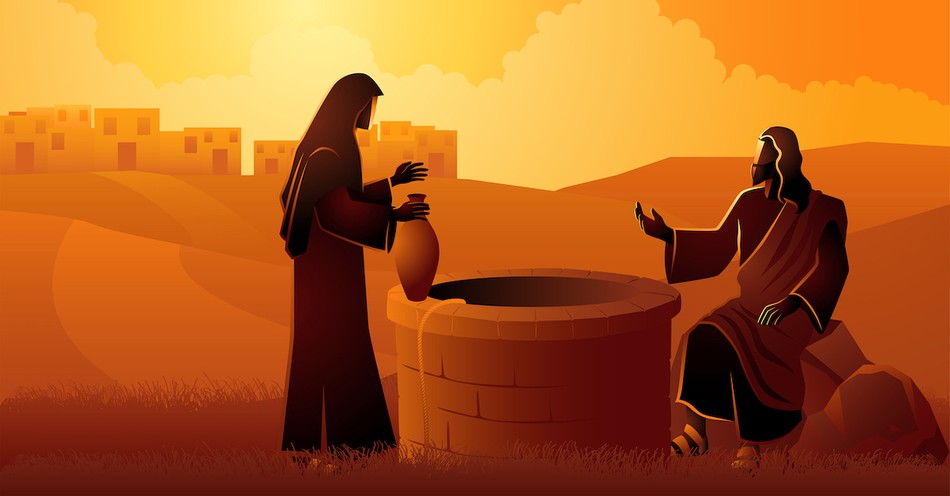
He stops at Jacob’s Well around noon — the hottest part of the day — and a woman comes to draw water alone. The cultural implications of this are important. In the ancient Near East, drawing water was a communal task, done by women together in the cool of the morning. If you were at the well at noon by yourself, everyone in town knew what that meant. You weren’t part of the morning group.
Jesus speaks to her first. He asks her for a drink of water, which breaks multiple social rules simultaneously. Jewish men didn’t initiate conversations with Samaritan women. She calls him on it directly: “How is it that you, a Jew, are asking me, a Samaritan woman, for a drink?”
He tells her that if she knew who she was talking to, she’d be asking him for water — living water. Water that doesn’t run out.
“Whoever drinks of the water that I will give him will never be thirsty again. The water that I will give him will become in him a spring of water welling up to eternal life.” — John 4:14
She’s still thinking about well water. Her response is almost funny: “Sir, give me this water, so I won’t be thirsty or have to keep coming here.” She’s not just tired of the walk. She’s tired of everything that has landed her at this well, at this hour, alone.
What It Means to Be Fully Known
Then Jesus shifts the conversation. He tells her to go get her husband. She says she doesn’t have one. And Jesus says quietly that she’s right — she’s had five husbands, and the man she’s living with now isn’t her husband.
We need to resist the impulse to judge her, because the text doesn’t. In first-century Judea and Samaria, women had almost no legal standing in marriage. Men could divorce their wives for nearly any reason; women could not initiate divorce at all. She could have been widowed. She could have been serially abandoned. She could have been trapped in a system that gave her almost no options and even less dignity. What we know is that her life has been hard, complicated, and publicly known — which is probably exactly why she’s at the well at noon.
And Jesus doesn’t dance around it. He doesn’t ignore it. He names it plainly — and then keeps the conversation going. He doesn’t walk away. He just… stays.
Think about how rare that is. To be fully known — the whole story, the complicated parts, the parts you’d rather people not know about — and to have the person across from you not flinch. Not pull back. Not find a reason to walk away.
That is what living water looks like in practice. It’s not just spiritual refreshment in the abstract. It’s being seen completely and finding out that what God sees doesn’t disqualify you. It’s dignity coming back to someone who had been treated like they didn’t have any.
The Church’s Complicated Relationship With the Well at Noon
Let’s be direct about something: the American church has not historically been great at sitting with people at the noon well. It has been better at the morning group — the people who show up on time, who have their lives arranged in ways that fit the expected categories, who don’t bring complications that make things awkward.
The people at the noon well — the ones with complicated histories, unconventional living situations, questions that don’t have tidy answers, lives that don’t fit the standard narrative — often know before they ever walk through a church door whether they’re actually welcome there. They read the room fast. And too often they’re right.
Jesus went through Samaria on purpose. He sat down at the wrong well at the wrong time and talked to the wrong person for way too long by the standards of everyone around him. His own disciples come back and are “amazed” that he’s talking to her — though to their credit, none of them actually say anything about it.
The detour was the point. The inconvenient conversation was the point. The person everyone had categorized and written off was the point.
And here’s what happened when Jesus treated her like she mattered:
“Many Samaritans from that town believed in him because of the woman’s testimony.” — John 4:39
The woman who had been sneaking to the well at noon to avoid people became the reason the whole town showed up. She left her water jar — literally forgot it in her excitement — and ran back to the people she’d been hiding from to tell them what happened.
That is what genuine encounter with Jesus does. It doesn’t just fill you up quietly. It sends you back out.
The Slow Drought
There’s a specific kind of spiritual dryness that lives mostly among people who have been in church for a long time. It’s not the dramatic crisis of faith — the big loss, the shattering doubt. It’s quieter and slower than that. It’s the gradual settling of faith into routine until the routine is doing most of the work and the actual relationship has gotten very quiet.
If someone you really trusted sat you down and asked: When did prayer last feel like an actual conversation instead of words aimed at the ceiling? When did reading Scripture last genuinely surprise you? When did you last walk out of a worship service and feel like something actually happened — what would you say?
That’s not a question designed to shame anyone. It’s the same question the Israelites asked from the desert: “Is the Lord among us or not?” It’s a real question that deserves a real answer.
The noise of modern life doesn’t help. There is more competition for your attention than any generation before us has had to navigate. The phone is always there. The news is always there. The scroll is always there. The quiet interior life — the place where real faith actually lives — gets crowded out slowly, and one day you realize the well feels dry and you can’t quite remember when that started.
The answer is not a program or a spiritual discipline checklist. The answer is the same thing it was in the desert and at the well: honesty. Showing up thirsty and saying so.
Reflection Question for This Week
Where is the dry place in your life right now — the place where faith has gone quiet, where God has felt distant, or where you’ve been going through the motions for so long you’ve stopped noticing? And is there someone you’ve been avoiding — or a conversation you’ve been walking around — that might actually be the well Jesus is already sitting at?
Closing Prayer
Lord,
We confess that we have been managing our thirst instead of naming it. We have filled the dry places with noise and routine and activity, and called it fine. We have passed the well at noon without stopping, because stopping would mean admitting something we’d rather not say out loud.
Forgive us for the ways we have made the faith small and the routine large. Forgive the church for building morning groups that didn’t leave room for the noon people. Forgive us for taking the long way around the hard conversations and the inconvenient people.
We come to you the way Israel came to that rock — not because we’ve kept it together, but because we’re thirsty and we’ve run out of other options. We come the way that woman came to the well — not expecting much, carrying more than we’ve told anyone about.
See us anyway. Name what’s true without flinching. And then stay. That’s all we’re asking for.
Because you promised that whoever drinks the water you give will never thirst again. We’re taking you up on that.
Amen.
Final Word
The Israelites showed up thirsty and panicked. The woman showed up alone and guarded. Neither of them had it together. Neither of them was particularly impressive in the moment.
God met them both anyway.
The woman left her water jar at the well. She forgot it entirely — the thing she came for, the thing that was the whole point of the trip. She went back to the town she’d been avoiding and told the people she’d been hiding from. And the town came out to see for themselves.
That’s what happens when the dry places get filled. You forget what you came for, because you found something better.
Name the thirst. Show up honest.
That was enough for them. It’s enough for you too.

 The Rest of the Sermon