
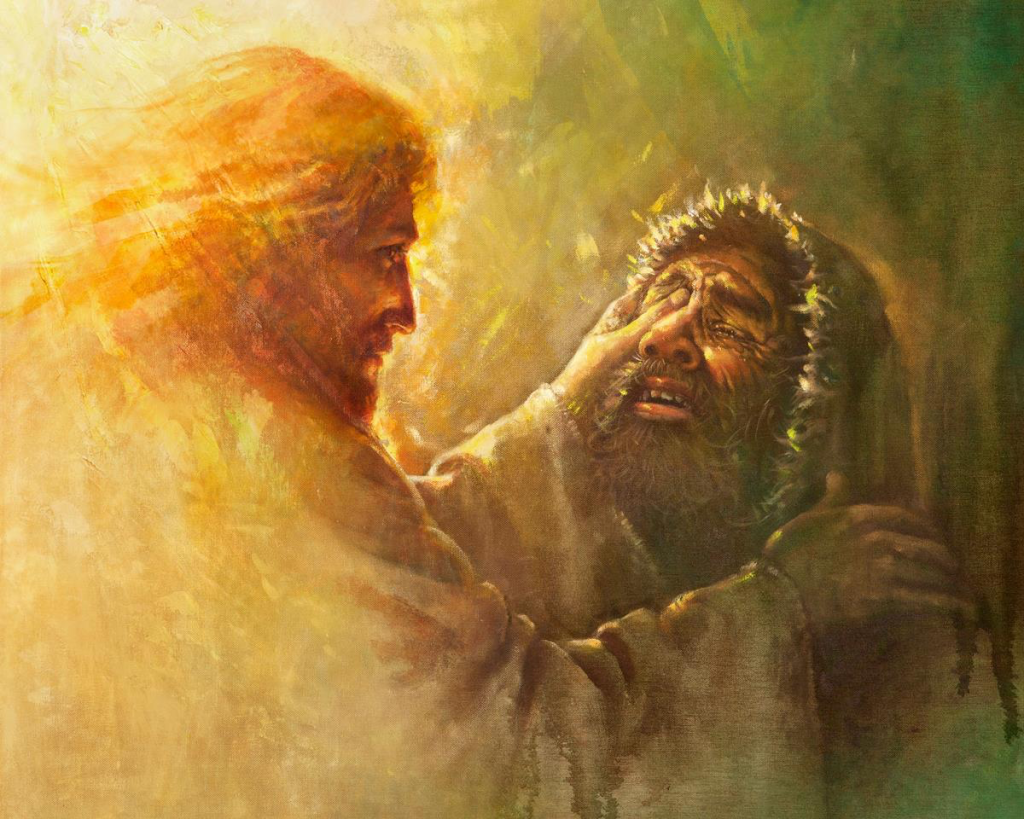
25 He replied, “Whether he is a sinner or not, I don’t know. One thing I do know. I was blind but now I see!” – John 9:25
There is a man sitting at the side of the road in John 9.
He has been there his whole life.
He was born blind, which in first-century Palestine meant exactly one economic option: beg. He sat at the edge of the road and hoped that people passing by had enough leftover generosity to toss something his way.
He was invisible.
People could see him. They just didn’t see him. There’s a difference.
Today, we are living in one of the most information-saturated moments in human history. We have more access to more content about more people and more news than any generation before us.
And somehow, we are seeing less clearly than ever.
We have opinions about everyone. We actually see almost no one.
The Man Nobody Saw
Jesus and his disciples are walking through Jerusalem. They pass the blind man, and the disciples do notice him, which is more than most people did. But watch how they notice him:
“Rabbi, who sinned, this man or his parents, that he was born blind?” (John 9:2)
They don’t ask his name. They don’t ask how he’s doing. They don’t wonder what his life is like or what he’s dreamed about or what he’s lost.
He becomes a theology question.
There is a human being — a whole person, shaped by decades of darkness and dependency — sitting right in front of them, and their first instinct is to turn him into a debate.
Sound familiar? Because we do this constantly.
Every person who is suffering or struggling in America right now has become an argument. Immigration is an argument. Poverty is an argument. Homelessness is an argument. Healthcare is an argument. We have gotten so trained to have opinions about people in need that we have almost entirely forgotten how to see them as people.
The disciples saw a theological problem to solve.
Jesus saw a person to restore.
Jesus kneels down, makes mud out of dirt and spit, and puts it on the man’s eyes. Then he tells him to go wash in the pool of Siloam.
The man goes. He washes. He comes back seeing.
For the first time in his life, he can see a face.
The People Who Couldn’t Celebrate
You’d think this is where the story gets simple. A man who was blind can now see. Celebration time.
It does not go that way.
His neighbors aren’t sure it’s really him, I mean, his whole posture has changed. They take him to the Pharisees. The Pharisees interrogate him. Then they call in his parents. Then they call the man back for a second round.
They are working so hard to discredit what happened that they completely miss what happened.
Their problem isn’t the man. Their problem is the timing. Jesus healed him on the Sabbath, and healing on the Sabbath technically violates the rules about work.
A man has his sight for the first time in his life, and the religious leadership’s response is: yes, but did it violate the work regulations?
This is not just ancient history. This is Tuesday night at most church board meetings in America.
We have built such complete systems, theological, political, cultural, that when something real happens that doesn’t fit the system, we have to find a way to disqualify it. Our certainty has become the thing that makes us blind.
The healed man, to his credit, is not having it. When the Pharisees push him to renounce Jesus:
“Whether he is a sinner I do not know. One thing I do know: I was blind, and now I see.” (John 9:25)
He doesn’t have a theology degree. He doesn’t know Sabbath law. He just knows what happened to him, and he refuses to talk himself out of it because the people in charge are uncomfortable.
That is one of the most quietly powerful things anyone says in the entire New Testament.
The American Church and the Problem of Comfortable Sight
Let’s be honest about something.
The American church, broadly speaking, with obvious exceptions, has spent the last decade becoming increasingly expert at seeing people the way the disciples saw the blind man. As problems. As categories. As arguments.
We have fused our faith with our politics so thoroughly that for many American Christians, the two are indistinguishable. And when that happens, we stop seeing people. We start seeing threats, allies, votes, and liabilities.
Jesus never once engaged a suffering person as a political category.
The lepers, the tax collectors, the Samaritan women, the Roman soldiers, the blind beggars, he didn’t see their demographic. He saw them. He stopped when everyone else kept walking. He touched people that respectable religious people didn’t touch. He talked to people that respectable religious people didn’t talk to.
And the religious leadership of his day hated him for it. Not because he was wrong, but because it was inconvenient. It messed with the labels. It disrupted the system.
If you find yourself reading about Jesus engaging people across every social line imaginable and thinking, “That was then” that’s worth thinking about. Because the same Jesus who stopped for a blind beggar on a busy road is the Jesus we claim to follow.
Paul writes to the church in Ephesus:
“For at one time you were darkness, but now you are light in the Lord. Walk as children of light.” (Ephesians 5:8)
Walk as children of light. Not think as children of light. Not vote as children of light. Not post as children of light.
Walk. It’s a directional word. It implies movement toward something. Or someone.
Awake, O Sleeper
Paul’s letter to Ephesus includes one of the more striking things you can say to a congregation:
“Awake, O sleeper, and arise from the dead, and Christ will shine on you.” (Ephesians 5:14)
These are not people who walked away from the faith. These are people who are present, gathering, learning, and spiritually asleep.
Going through the motions. Participating without paying attention. Faithful in behavior, numb in awareness.
This is the real danger the American church faces right now. Not atheism. Not persecution. Not decline in numbers, though that’s real.
The danger is sleepwalking.
Being present but on autopilot. Believing the right things while being asleep to the person right in front of you. Having a perfectly consistent theology and being completely blind to what God is actually doing.
The Pharisees in John 9 were not evil people. They were serious, committed, studious. They were trying to honor God. They just built such a complete system that there was no longer room in it for anything new. Their certainty sealed them off.
Sound like anyone you know? Sound like any institutions you’ve been part of?
What Seeing Actually Costs
Here’s the part of this story we tend to skip.
After the healed man refuses to back down, after he holds his ground in front of the most powerful religious figures in his world, they throw him out of the synagogue.
In that culture, being expelled from the synagogue wasn’t just a religious consequence. It was social exile. It was being cut off from your community, your support network, your identity.
This man, who just got the greatest gift of his life, lost his community the same week he got his sight.
Following Jesus and actually seeing what he’s doing and going where he goes has always had a cost.
The Pharisees paid no cost because they never moved. Their certainty kept them comfortable and blind. The healed man paid a real cost because he refused to unsee what he had seen.
Paul doesn’t let us off gently here either:
“Take no part in the unfruitful works of darkness, but instead expose them.” (Ephesians 5:11)
Walking as children of light is not a passive spiritual aesthetic. It means your vision changes how you live. It means what you see makes a claim on you.
If you see a person being treated as invisible, you are no longer neutral. If you see someone being reduced to a debate point, you know better. If you see the institutional machinery working to discredit something real because it’s inconvenient, you’ve seen it.
And you can’t unsee it.
So What Do We Do?
The healed man sets the example for us. He doesn’t have it all figured out. He can’t out-argue the Pharisees on Sabbath law. But he knows what happened to him, and he says so plainly:
“I was blind, and now I see.”
Start there.
You don’t need to have the perfect political framework or airtight theological system. You need to be honest about what you’ve actually experienced of Jesus, and honest about the gap between that and how you’ve been living.
This week, Paul’s question for the Ephesians is worth asking yourself honestly:
What have I stopped noticing?
It might be a person you’ve been stepping around.
It might be a comfortable assumption you’ve stopped questioning.
It might be the quiet awareness that your faith has become a system rather than a relationship — and that somewhere in building the system, you stopped actually seeing.
Jesus stops where everyone else keeps walking.
He stopped for the man nobody saw.
He is still asking the same question: do you want to see?
CLOSING PRAYER
Lord, most of us came in here today partially awake.
We’ve got opinions, positions, and a fairly complete picture of how the world works — and we are asking you to disrupt it.
Open our eyes to the person we’ve been stepping around.
Give us the courage of the healed man — who didn’t have all the answers, but knew what happened to him, and refused to take it back.
And when seeing costs us something — comfort, certainty, the approval of people whose approval we want — remind us what it cost him.
We were blind, and now we see.
Let that be enough to keep us walking.
In Jesus’ name. Amen.
REFLECTION QUESTION
Who or what have you been stepping around? Ask yourself: is there a person, a situation, or an uncomfortable truth that you’ve learned to walk past without really seeing?

 The Rest of the Sermon