
Have you ever prayed for something — and gotten nothing back?
Not a no. Not a yes. Just silence.
Week after week. Month after month. Maybe years. And you’re starting to wonder if the line is even connected anymore.
If that’s where you are, this week’s texts are for you.
Because the people in these passages weren’t people who had given up on God. They were people still talking to God while wondering if God was listening. Ezekiel was preaching to a nation that had been in exile long enough to forget what home felt like. Mary and Martha called Jesus when their brother was dying — and he didn’t come. The psalmist was crying out from “the depths.” These are not the words of people who had stopped believing. These are the words of people whose belief was being tested by delay.
And here’s the uncomfortable question underneath all of it: when hope feels delayed, what do we reach for?
THE VALLEY IS REAL — AND GOD KNOWS IT
God took Ezekiel to a valley full of bones. Not a slightly wilted garden. Not a situation that just needed a little encouragement. A battlefield graveyard. Sun-bleached. Wind-scattered. The text says there were “very many” bones and they were “very dry” (Ezekiel 37:2). This was total desolation.
And God asked Ezekiel a question: “Can these bones live?”
Ezekiel’s answer is honest: “Sovereign Lord, you alone know.”
That’s not a confession of doubt. That’s a confession of limits. Ezekiel has been around long enough, has seen enough exile and silence, that he’s stopped making confident predictions about what God will or won’t do. He holds the question open. That’s actually a form of faith — maybe the deepest kind.
We live in a culture that cannot tolerate waiting. Same-day delivery. Thirty-second news cycles. Instant everything. And that posture has bled into the spiritual lives of a lot of people in ways we don’t talk about enough. If God hasn’t answered this prayer yet, something must be wrong — with me, with God, with the whole thing.
But the valley in Ezekiel isn’t evidence that God has abandoned the situation. The valley is where God shows up.
JESUS WAITED. ON PURPOSE.
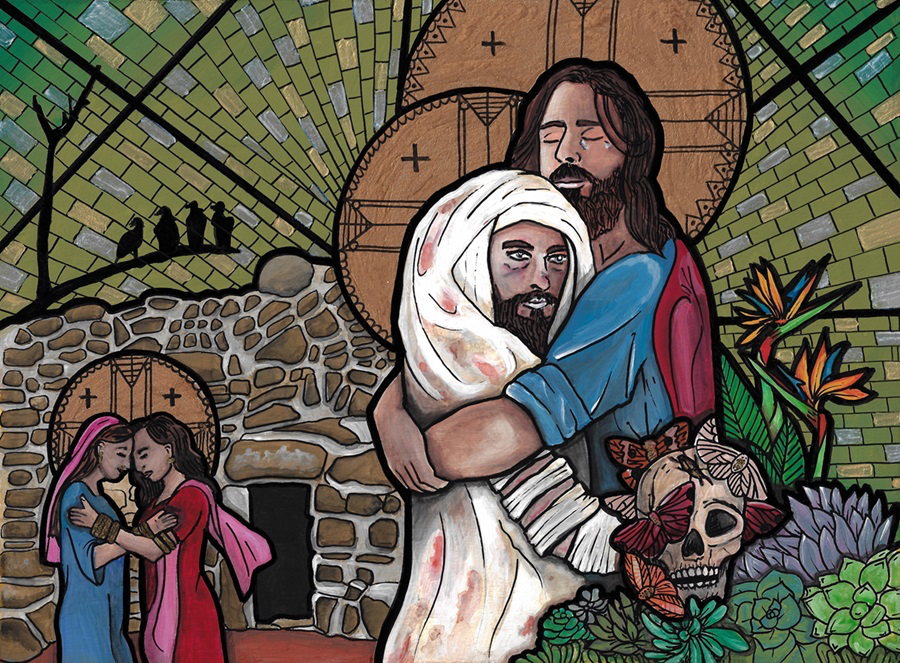
The story of Lazarus in John 11 is a shocking moment because Jesus behaves in a way that makes almost no sense from where Mary and Martha are standing.
They send word: “Lord, the one you love is sick.” Not a dramatic plea. Just a statement of fact, trusting Jesus would act on it.
John then tells us: “When he heard this, Jesus stayed where he was two more days” (John 11:6).
He waited. On purpose. Lazarus died. And Jesus waited.
By the time Jesus arrived, Lazarus had been in the tomb four days. Martha came out to meet him and said, “Lord, if you had been here, my brother would not have died” (John 11:21).
She wasn’t accusing him. But she wasn’t hiding her hurt either.
Somewhere along the way, a significant portion of the American church got the idea that expressing honest disappointment to God is a sign of weak faith. We’ve built a version of Christianity that requires a performance of certainty — where doubt is weakness and lament is failure. But the Psalms are full of complaint. “How long, Lord? Will you forget me forever?” (Psalm 13:1).
God can handle your honest feelings. God is not fragile.
The delay in John 11 wasn’t indifference. Jesus told his disciples before they went: “This sickness will not end in death. No, it is for God’s glory” (John 11:4). He knew what he was doing. The waiting wasn’t absence. It was setup.
That’s difficult to hear in the middle of the waiting. But it’s true. Sometimes what looks like God’s absence is God arranging something that couldn’t have happened any other way.
JESUS WEPT
Verse 35 of John 11 is famous for being the shortest verse in the Bible: “Jesus wept.”
He knew he was about to raise Lazarus. He had already told his disciples. He knew the end of the story. And still, when he saw Mary weeping and the people around her grieving, John says he was “deeply moved in spirit and troubled” (John 11:33).
The Greek word there is embrimaomai. It’s not just an emotional response. It’s closer to indignation, agitation, a disturbance in the gut. Jesus was not neutral about human suffering. He was not a detached divine observer watching from a comfortable distance. He entered into the grief. He sat in it. He cried in it. Even though he already knew how it would end.
This is important for anyone who is in a valley right now.
The Christian faith does not promise that God will remove every hard thing from your life. It promises that God will be in the hard thing with you. Those are not the same promise. And a lot of people have walked away from faith because they were sold the first one and got the second one instead — and nobody was honest enough with them to tell them that was always what was being offered.
Paul writes in Romans 8 that “the Spirit himself intercedes for us through wordless groans” (Romans 8:26). When you don’t even have words for what you’re going through, the Spirit is already in it with you, speaking on your behalf.
THE BONES DON’T MOVE UNTIL SOMEONE SPEAKS
Back in Ezekiel 37, God tells Ezekiel to do something that had to feel ridiculous: speak to the bones.
“Prophesy to these bones and say to them, ‘Dry bones, hear the word of the Lord!’” (Ezekiel 37:4)
Standing in the middle of a field of sun-bleached skeletons, talking to them. Anyone watching from a distance would have been deeply concerned. But Ezekiel spoke. And the bones rattled. They came together. Muscle and flesh appeared. Breath came into them, and they stood.
The bones didn’t reassemble themselves before Ezekiel spoke. God waited for Ezekiel to participate in the process. God’s power moved in response to a human voice carrying a divine word.
In John 11, Jesus commanded the people around him to “take away the stone” (John 11:39). Martha pushed back — “but Lord, by this time there is a bad odor.” And Jesus said, essentially: trust me, and move the stone.
They moved it. Then the miracle happened.
There is a persistent temptation to wait passively for God to do everything while doing nothing ourselves. But the biblical pattern is different. God often works through ordinary human faithfulness. Through showing up. Through praying anyway. Through speaking hope out loud even when you’re standing in a valley and the evidence is against you.
WHEN WE STOP WAITING ON GOD AND START WAITING ON WASHINGTON
Here’s something that a lot of churches will never admit: a significant portion of American Christianity has quietly replaced hope in God with hope in political power.
It didn’t happen all at once. It never does.
It happened the same way Adam reached for the fruit in Genesis — slowly, with a kind of plausible logic at every step. The culture is changing. Values are under threat. The church is shrinking. Something has to be done. And if God is taking too long, well — there are other options. There are politicians who say the right things. There are movements that promise to put things back the way they were. There are leaders who sound certain when everything else feels uncertain.
And so, instead of sitting with the discomfort of delay and choosing trust the way Ezekiel did, the way Martha did, the way the psalmist did — a large chunk of the American church has fused its identity with a political tribe and called it faithfulness.
This is not a partisan observation but a theological one.
When your political anger is more reliable than your prayer life, something has gone wrong. When your sense of hope rises and falls with election results rather than with the promises of Scripture, something has been replaced. When you find it easier to demonize the other side than to sit in honest lament before God, you haven’t found a replacement for faith — you’ve found a counterfeit.
Jesus was explicit. “My kingdom is not of this world” (John 18:36). He said it plainly, under pressure, when it would have been politically advantageous to say something else. The Roman Empire was the superpower of its day, and Jesus was not running for office in it. He was building something that would outlast it.
The American church’s infatuation with political power is, at its core, a loss of hope in God’s ability to act. It’s the valley of dry bones, and instead of waiting for the breath of God, we’re trying to wire the bones together ourselves with legislation and culture war.
That doesn’t work. The bones stay dead.
Ezekiel didn’t build a political coalition to restore Israel. He stood in the valley and spoke the word of God. Mary and Martha didn’t mobilize to pressure Rome into fixing things. They called Jesus. The psalmist didn’t look to the surrounding nations for rescue. He looked to God.
“I wait for the Lord, my whole being waits, and in his word I put my hope” (Psalm 130:5).
Not in the Lord’s party. Not in the Lord’s preferred candidate. In the Lord.
WHAT DO WE ACTUALLY DO WITH THIS?
Paul writes in Romans 8: “And if the Spirit of him who raised Jesus from the dead is living in you, he who raised Christ from the dead will also give life to your mortal bodies because of his Spirit who lives in you” (Romans 8:11).
The same Spirit — the same power — that raised Jesus from the dead is living in people who follow Jesus right now. Not a watered-down version. The same Spirit.
That’s easy to say on a Sunday morning and hard to hold on to on a Wednesday afternoon when your situation hasn’t changed and the news is doing what the news does.
But the invitation here isn’t to be more optimistic. Optimism is just wishful thinking with an attitude adjustment. The invitation is something harder and more specific: hold on to a God who has never once been stopped by a situation that looked finished.
So here’s what that might actually look like:
Name honestly to God the thing that feels dead right now. Don’t dress it up. Don’t perform faith you don’t feel. Bring the dry bones out into the open and say, “Lord, you see this. I don’t know if this can live again. But you alone know.” That’s enough. It counts.
Stop the doom-scroll spiral. Not because the problems aren’t real, but because the Spirit who raised Jesus from the dead is at work in the world whether you’re monitoring it or not. And obsessive news-watching is not the same thing as faithful engagement. One produces anxiety. The other produces action.
Show up for someone in a valley. Sit with them. Be present. That’s what Jesus did — he wept first, then he worked the miracle. Presence before power.
Roll away a stone you’ve been guarding. Something in your life or your faith that’s been sealed up, and you’ve made peace with it staying that way because opening it might hurt or be embarrassing. Jesus is standing at that door saying, “I am the resurrection and the life” (John 11:25).
THE ASSESSMENT IS NOT FINAL
Easter is coming. But between the wilderness and resurrection, there is this: a valley of dry bones. A man in a tomb four days dead. A God who weeps and still says, “Come out.”
The bones can live. The tomb is not the end. The church — fragmented, politically compromised, numerically declining as it may be — is not beyond what God can do.
But resurrection doesn’t come from doubling down on control. It doesn’t come from finding the right political ally or the right cultural strategy. It comes from the same place it always has: the Spirit of God moving through people willing to speak the word, move the stone, and trust the one who goes into tombs and comes back out.
“God specializes in situations that look finished.”
Hold on to that this week.
Reflection Question
Where have you quietly stopped waiting on God and started waiting on something else — a political outcome, a cultural shift, a person — to make things right? And what would it look like to bring that specific thing back to God this week, honestly and without pretending?
Closing Prayer
Lord, forgive us for the times we’ve mistaken your silence for absence. Forgive us for the prayers we’ve quietly stopped praying because the answer took too long — and for the things we picked up to fill the gap.
We confess that it’s easier to rage at the news than to sit in honest lament before you. It’s easier to put our hope in a political movement than to hold on to a promise that requires we actually trust you. We’ve been reaching for fruit again, and we’ve called it strategy.
So we bring the dry bones today. The ones in our own lives, in our families, in our churches, in our country. Not with confidence that we know how it ends — but with the honesty of Ezekiel: “Sovereign Lord, you alone know.”
And we ask for the faith to speak anyway. To move stones anyway. To show up for people in valleys, to pray honestly, to hold on to the truth that you have never once been stopped by a situation that looked finished.
Easter is coming. Let us live like we believe it.
Amen.

 The Rest of the Sermon