
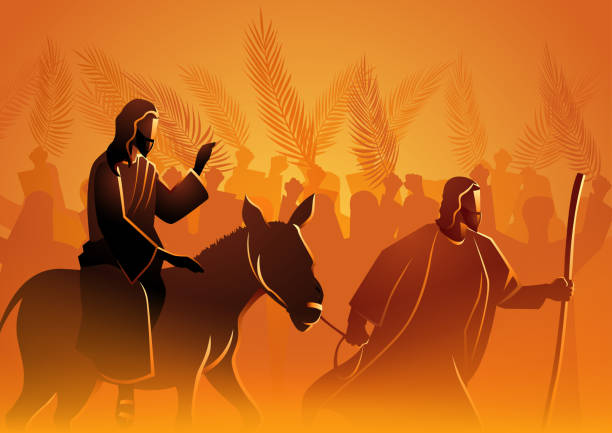
There is something hopeful about Palm Sunday.
The palm branches. The singing. The festive chaos of a crowd that genuinely believes the moment they’ve been waiting for has finally arrived. It reads like a victory parade. And for one brief, loud, joyful afternoon it felt like one.
Then Friday happened.
The crowd that shouted “Hosanna!” on Sunday was shouting “Crucify him!” by Friday. Same city. Same week. Some of them probably the same people.
Which raises the question: What, exactly, did they think was happening?
A King, A Donkey, and a Very Old Promise
Before Jesus entered Jerusalem, he made a deliberate, premeditated choice. He sent disciples ahead to find a donkey, not a horse, not a chariot, not any of the things that announced military power in the ancient world. A donkey.
Matthew quotes the prophet Zechariah, who wrote this five hundred years earlier:
“Behold, your king is coming to you, humble, and mounted on a donkey, on a colt, the foal of a beast of burden.” — Matthew 21:5, quoting Zechariah 9:9
Every person in that crowd would have known Zechariah. This was not an obscure text. And they would also have known what came right after it:
“I will cut off the chariot from Ephraim and the war horse from Jerusalem; and the battle bow shall be cut off, and he shall speak peace to the nations.” — Zechariah 9:10
This is critical context that gets lost when we sentimentalize the story. A king on a donkey was not a sign of weakness, it was an ancient sign of a king arriving in peace, without weapons, ready to govern rather than conquer. Warring kings rode warhorses and carried swords. Jesus was making a statement before he said a word.
He was saying: I am the king you’ve been waiting for. Just not the kind you’ve been expecting.
The crowd heard the first part. They missed the second. They saw “king” and filled in the rest from their own desperately held hopes, Roman occupation ending, Israel restored to glory, enemies finally defeated. They wanted a liberator with a sword. They got something harder to understand: a liberator who would absorb the sword instead of wield it.
The City Shook. They Still Didn’t Get It.
When Jesus entered Jerusalem, Matthew uses the word seismos, the city was shaking, trembling, the same word used for earthquakes. This was not a quiet moment. The crowd was electric with expectation.
And when the city asked, “Who is this?” the crowd answered: “The prophet Jesus, from Nazareth of Galilee.”
A prophet. From Nazareth. After everything they had witnessed, the healings, the feeding of thousands, the raising of Lazarus, they called him a prophet from a nowhere town.
They weren’t entirely wrong. But they were dramatically underselling what was in front of them.
We tend to see in Jesus what we need him to be. And we miss what he actually is.
This is not an ancient problem. It is our problem, right now, today.
The version of Jesus that dominates a significant portion of American Christianity in 2026 looks remarkably like the crowd’s version from Palm Sunday. Powerful, triumphant, on our side, here to defeat our enemies and restore our place in the culture. A warrior king who validates our politics, protects our preferences, and shows up to bless whatever we were already planning to do.
That Jesus is not in the text. He never was. He rode a donkey into a city he knew would kill him, and he did it on purpose.
He Knew Exactly Where the Road Led
Here is what should humble us about the passion narrative: Jesus knew.
He didn’t ride into Jerusalem swept up in the excitement, only to be blindsided when the week turned dark. He knew the religious leaders wanted him dead. He knew Judas was already in motion toward betrayal. He knew the voices shouting his praises on Sunday would be demanding his execution by Friday.
And he kept riding.
The prophet Isaiah, writing centuries before the crucifixion, described it in language so specific it’s almost uncomfortable:
“I gave my back to those who strike, and my cheeks to those who pull out the beard; I hid not my face from disgrace and spitting. The Lord God helps me; therefore I have not been disgraced; therefore I have set my face like a flint, and I know that I shall not be put to shame.” — Isaiah 50:6–7
Set my face like a flint. Luke uses almost the same language in chapter 9: “He set his face to go to Jerusalem.” Absolute, unshakeable resolve. Not resignation. Not defeat. Intentional movement toward the hardest thing.
Jesus didn’t stumble into the cross. He walked toward it because he understood something the crowd couldn’t yet see: the only way through death was through death. The only way to break what had been broken about the human story was for someone to take the full weight of it, absorb it completely, and come out the other side.
That’s what was happening on the road into Jerusalem. An act of love so enormous and so costly we’re still trying to fully take it in two thousand years later.
The Mind of Christ Versus the Mind of the Crowd
Paul writes to the church in Philippi, a church in a Roman colony, a place where imperial power was visible and celebrated daily, and he tells them something countercultural enough to get people killed:
“Have this mind among yourselves, which is yours in Christ Jesus, who, though he was in the form of God, did not count equality with God a thing to be grasped, but emptied himself, by taking the form of a servant, being born in the likeness of men. And being found in human form, he humbled himself by becoming obedient to the point of death, even death on a cross.” — Philippians 2:5–8
This passage is called the kenosis, from the Greek word for “emptying.” Paul is saying that the defining posture of Christ was self-emptying, not self-assertion. Downward movement, not upward grasping. Service, not dominance.
And then Paul says: have this mind among yourselves.
Not admire this mind from a distance. Not study it academically. Have it. Let it shape the way you relate to each other, to outsiders, to people who disagree with you, to people who hold less power than you do.
The cross is not a symbol of power the way the world understands power. It is a symbol of love that refuses to stop loving even when it costs everything.
This is where things get awkward for the American church.
A significant strand of Christianity in America has drifted, or in some cases, sprinted, toward exactly the opposite of what Paul describes. The church, in many quarters, has become a vehicle for cultural power, political influence, and tribal identity. The Jesus being proclaimed in some of those spaces is a Jesus who validates the pursuit of dominance, who blesses the in-group’s agenda, who is essentially a divine endorsement for whatever the crowd already believes.
That is the Palm Sunday crowd’s Jesus. And that Jesus couldn’t save anyone because he was a projection, not a person.
The real Jesus washed his disciples’ feet the night before they abandoned him. He told Peter to put the sword away. He said “Father, forgive them” from the cross while they were still killing him.
Every instinct he displayed runs directly against the grain of how power works in our world. And that is not an accident. That is the whole point.
The Mold the World Is Pressing Us Into
Paul also writes to the Romans: “Do not be conformed to this world, but be transformed by the renewal of your mind.” (Romans 12:2)
That word “conformed” carries the image of being pressed into a mold. The world has a mold. It’s running constantly, quietly, and it is more effective than most of us want to admit.
The mold says that your people matter and their people don’t. It says that winning is the point. It says that the other side isn’t just wrong, they’re evil, dangerous, enemies to be defeated. It says that strength is what counts and that vulnerability is for losers. It says that when your tribe gains power, that’s justice, and when the other tribe gains power, that’s tyranny.
This mold is pressed on all of us. It lives in our news feeds and our comment sections and our family group chats and our church lobbies. And it has been remarkably, devastatingly successful at reshaping how even sincere believers talk about their neighbors.
Jesus refused the mold at every turn.
He entered Jerusalem on a donkey when the crowd wanted a warhorse. He spent his last free evening washing feet instead of rallying troops. He stood silent before Pilate when he could have called down angels. He died between two criminals and promised paradise to one of them.
None of that looks like winning. Not by the world’s definition. But it is the only thing in all of human history that actually broke the grip of death.
Faithfulness sometimes looks like loss. Jesus knew that going in. And he walked it anyway.
Which Jesus Are You Following?
Palm Sunday asks a harder question than “Do you believe in Jesus?”
It asks: Which Jesus?
The one who confirms your existing opinions and rallies to your side? Or the one on the donkey, who refused every opportunity to be the kind of king the world respects, and walked straight into suffering because the people he loved needed him to?
Those are genuinely different roads. The crowd’s version of messianic power ended on a hill outside Jerusalem. The real thing walked out of a tomb three days later.
If you’re not religious, or you’re suspicious of religion for good reasons, including because of the very things named above, then here’s what I want to say to you directly: the Jesus described in the Gospels looks almost nothing like the version being sold in a lot of American churches right now. The man in the text is radically humble, almost unsettlingly compassionate, and is consistently harder on the powerful than on the marginalized. He forgave people who were killing him.
That person is worth taking seriously, regardless of what you think of organized religion.
And for those of us inside the church: Holy Week is the season when the comfortable, triumphant version of faith gets stripped away, if we’ll let it. Between now and Easter, we walk through the last supper, the garden, the arrest, the cross, and the silence of Holy Saturday.
Don’t rush past those days. Don’t skip straight to resurrection because the middle is uncomfortable. The empty tomb means more when you’ve sat with the stone in front of it.
REFLECTION QUESTION
The crowd saw in Jesus exactly what they wanted to see, a king who would restore their power and defeat their enemies. In what ways might you be doing the same? Where have you shaped Jesus around your preferences, your politics, or your fears, rather than letting him reshape you?
CLOSING PRAYER
Lord Jesus, you rode into Jerusalem knowing exactly what waited there. No illusions. No detours. You set your face and kept moving, for us.
We confess that we don’t always follow that Jesus. Too often we follow the easier version, the one we’ve built around our comfort, our tribe, our desire to win. Forgive us for mistaking our preferences for your will, and our power for your kingdom.
This week, as we walk through the darkness before Easter, keep us close to the real story. Don’t let us rush past the garden or the cross to get to Sunday. Meet us in the hard places. Shape us into people who look less like the crowd and more like the man on the donkey.
Humble us. Reorient us. And make us brave enough to follow where you actually lead.
Amen.

 The Rest of the Sermon