
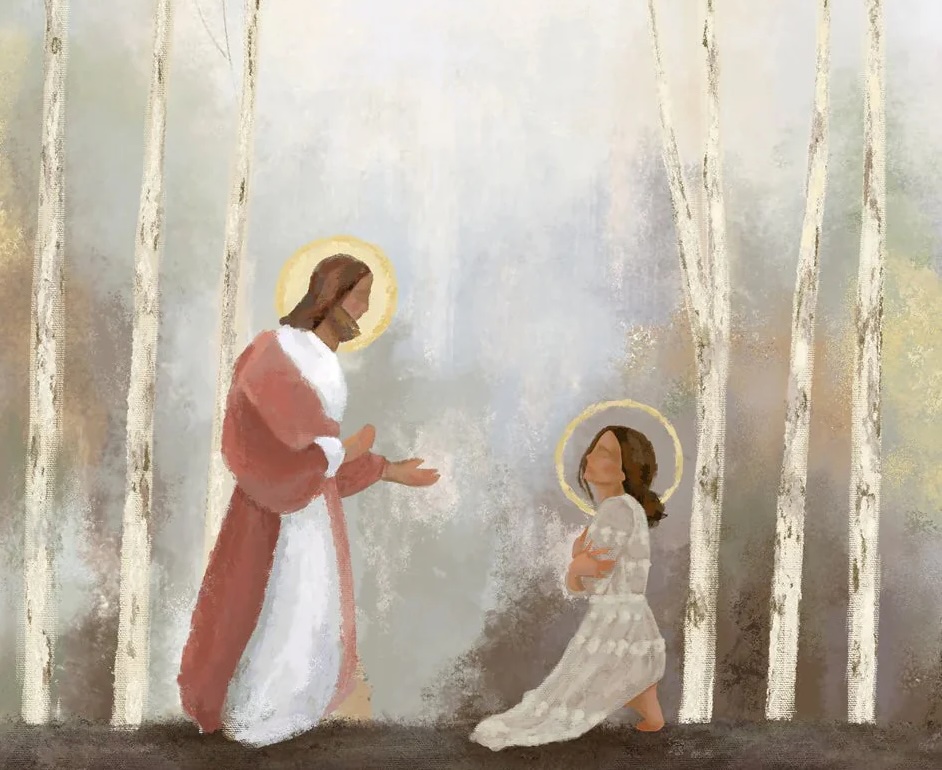
Mary Magdalene didn’t go to the tomb expecting good news.
She went because she loved someone who was dead and she didn’t know what else to do. John is very deliberate about telling us it’s still dark when she arrives.
She gets there and the stone is gone.
Her first thought isn’t resurrection. Her first thought is that someone has stolen the body.
It wasn’t a failure of faith. That’s what human beings do when they’ve been through something terrible. You don’t leap to the most hopeful explanation. You assume the next bad thing.
What We Do With Easter
These days I believe most of us celebrate Easter without letting it actually touch us.
We get dressed up. We sing the hymns. We eat the ham. And then Monday arrives and we go back to being exactly who we were before: anxious, guarded, running on the same fear we walked in with.
That’s not a critique of family traditions. Those things are fine. The problem is when the ritual becomes a substitute for the encounter. When we observe resurrection as a historical event with no bearing on how we live right now, in this week, in our actual lives.
John isn’t just writing a historical account of what happened on a Sunday morning outside Jerusalem. He’s inviting you into something. The question he keeps pressing throughout his story is this: will you let this change you?
Most of us, if we’re honest, would rather not.
Change is uncomfortable. It costs something. And we have carefully arranged lives that don’t really have room for the kind of disruption that resurrection implies.
He Believed Without Fully Understanding
When Peter and the other disciple arrive at the tomb, they see the burial cloths lying there. The face cloth is folded separately, a detail so specific that it clearly mattered to someone who was there.
And John writes about himself: the other disciple saw and believed. But then he adds another detail:
“for as yet they did not understand the Scripture, that he must rise from the dead.” — John 20:8–9
He believed. He didn’t fully understand. Both things were true at the same time.
That’s where a lot of people are, not just people who are new to faith, but people who have been in church for decades. Something happened here. Something real. We’re just not entirely sure what we’re supposed to do with it.
There’s no shame in it. It’s an honest place to be. And honesty, in my experience, is usually where actual faith begins rather than where it ends.
Peter and the other disciple go home. Maybe to think it over, to talk it through, to try to make sense of what they saw.
Mary stays.
The Gardener Who Says Your Name
Mary is standing outside the tomb, still weeping, and she turns and sees a man she doesn’t recognize. She assumes he’s the gardener. She just wants to know where they’ve put the body.
And then Jesus says one word.
Her name.
“Mary.”
And she knows.
This is one of the most quietly devastating moments in all of Scripture. Not devastating in a terrible way, devastating in the way that something enormous and unexpected hits you before you have time to brace for it.
Jesus had already told his disciples: “He calls his own sheep by name and leads them out. The sheep follow him because they know his voice.” (John 10:3–4) This is what it looked like in practice. One word. Her name. And everything she thought was finished turned out to be just beginning.
We live in a world that is extraordinarily good at making people feel invisible. You get sorted into categories; demographics, income brackets, political camps, useful or not useful. Social media gives you the illusion of connection while delivering loneliness. People are labeled and dismissed, seen as problems or liabilities rather than as human beings with names.
Into all of that, Easter announces something that sounds almost absurdly simple: the God of the universe knows you by name.
Nothing else that the world would use to categorize you.
Your name.
Don’t Cling — Go
Mary reaches for Jesus, grabs hold of him, and he gently tells her not to cling.
“Do not hold on to me… but go to my brothers and tell them…” — John 20:17
This is a harder word than it sounds. Because what Mary wants in this moment is completely understandable. She has her teacher back. She wants to hold on, to return to something familiar, to stay in this moment forever.
But Jesus doesn’t let her.
He gives her a mission instead.
It’s worth noting who he chooses as the first witness of the resurrection, the first person entrusted with the most important announcement in human history: a woman, in a first-century culture where women’s testimony wasn’t considered legally valid. This was not an accident. Jesus consistently handed dignity and purpose to people the surrounding culture had written off.
The church has not always been good at remembering this.
There’s a version of Christianit, and it’s very common in America right now, that is primarily interested in preservation. Keeping things the way they were. Protecting what’s familiar. Holding on to a Jesus from the past rather than following a risen Jesus into the present.
Jesus keeps saying the same thing he said to Mary: don’t just hold on. Go. There is work to be done. The resurrection is not a finish line. It’s a starting block.
Living Like Easter Didn’t Happen
Here’s the part of this conversation that I think needs to be said directly, because the American church in 2026 has a real problem in this area.
A significant portion of Christians in this country are living in profound fear, fear about the economy, fear about culture, fear about losing influence and status. And fear, when it gets into a community of people, does predictable things. It makes people smaller. It makes them turn inward. It makes them reach for power and control as a substitute for trust.
We have watched, in real time, a large segment of American Christianity decide that the solution to its fear is political power. That if we can just get the right people in the right positions, if we can just win the right battles, then things will be okay. That the kingdom of God can be ushered in — or at least protected — by the right election results.
I want to say this as clearly as I can: that is not Easter faith. That is not resurrection faith. That is a community of people acting as though the tomb is not empty.
The resurrection means that death itself has been defeated. Not just dealt with. Defeated.
If you actually believe that, then the question of who holds political power — while not irrelevant — is simply not the most important thing in the world. The church’s mission doesn’t depend on favorable legislation. The kingdom of God doesn’t rise or fall with any election. Jesus is not waiting on Congress.
When fear drives the church toward power-seeking, toward tribalism, toward treating certain groups of people as threats rather than neighbors, toward the kind of Christianity that is more interested in cultural dominance than in the costly love of actual human beings, that’s a community that has forgotten what day it is.
It’s Sunday. The tomb is empty. Act like it.
The Difference Between Hope and Optimism
Easter is not optimism. Optimism is a personality type, some people have it, some don’t, and it correlates with things like temperament and life circumstances and whether you slept well.
Hope is different. Biblical hope isn’t a feeling. It’s a conviction about who holds the future.
Mary didn’t walk away from that garden because things suddenly looked good. Nothing had been fixed yet. The Roman Empire was still there. The religious establishment that had Jesus killed was still there. Her life was going to remain hard and uncertain and costly.
But she had encountered something that reframed all of it. She had heard her name spoken by someone who wasn’t supposed to be able to speak anymore. And that changed her direction.
That’s what resurrection hope looks like in practice: not pretending everything is fine, not naive positivity, but a reorientation toward the God who raises dead things. Toward the conviction that the worst thing is never, in fact, the last thing.
Paul puts it this way in Romans 6 — those who are connected to Christ’s death and resurrection have been brought into newness of life. Not newness of afterlife. Not biding time until we die and go to heaven. Newness of life, present tense.
The patterns of death: bitterness, fear, self-protection, comfortable Christianity, those patterns don’t have to win. You are not stuck. God raises dead things.
What This Actually Asks of Us
So here’s the honest question that Easter speaks to us: what would change about your life this week if you really believed that the same power that raised Jesus from the dead is at work in you right now?
Not in some vague spiritual sense. In your actual life. In the relationships that are strained. In the anger that you’ve been feeding. In the fear that you’ve been managing so long you’ve started calling it wisdom.
How would you treat the person who drives you crazy?
How would you respond to the need on your street, in your town, in the people who are different from you and who don’t fit neatly into your category of people worth caring about?
How would you approach the place in your own soul where things have gone dry and stuck and you’ve quietly given up?
Mary went to a tomb to mourn and left carrying good news. She went expecting an ending and left carrying a beginning.
That’s what the resurrection does. It changes your direction.
REFLECTION QUESTION
Where in your life are you living as though Easter didn’t happen, holding on instead of going, choosing fear instead of trust, seeking control instead of the costly freedom of resurrection? What would it look like this week to let the empty tomb change your direction?
CLOSING PRAYER
Lord Jesus, you called Mary’s name in a garden when she was sure the story was over.
Call our names today.
We confess that we know more about managing fear than we do about trusting resurrection.
We confess that our churches have sometimes looked more like institutions trying to survive than communities living like death has actually been defeated.
We confess that we cling — to what’s familiar, to what’s comfortable, to power we think will make us safe — instead of going where you send us.
Forgive us. And then send us anyway.
Give us resurrection faith — not optimism, not positive thinking, but the stubborn, costly, world-reorienting conviction that the worst thing is never the last thing.
Send us into this week a little breathless, a little changed, with something worth telling.
Because the tomb is empty. And that changes everything.
Amen.

 The Rest of the Sermon