
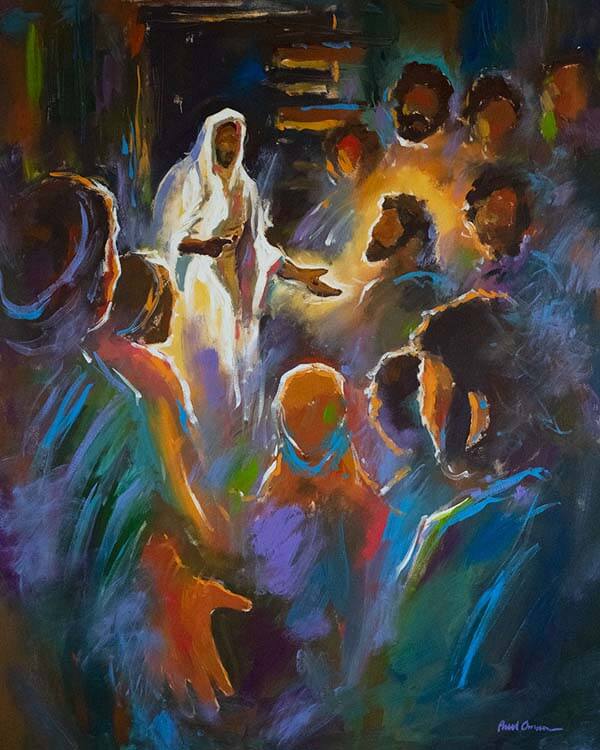
Scripture: John 20:19–31
Easter was last week.
The tomb is empty. Mary has heard her name spoken in a garden. The stone is rolled away. Victory.
And now, in John 20, we find the disciples — the people who were closest to Jesus, who saw what he did, who heard what he said — huddled in a room with the doors locked.
John doesn’t let us skip over this detail. The doors are locked. They are afraid. And honestly? They have been afraid since Friday.
The resurrection has already happened. And these people are still hiding.
Sound familiar?
The Room We Don’t Mention
We prefer the triumphant Easter narrative. The empty tomb. The alleluias. The lilies and the brass section.
But John places us in a locked room full of frightened people on this second Sunday of Easter.
Because that’s where most of us actually are.
Not at the triumph, but in the room.
Some of us have locked the door on hope because the last time we hoped for something, it didn’t work out, and we decided we couldn’t survive that again. So we stopped hoping. We call it being realistic. But really, it’s just a locked door.
Some of us have locked the door on authentic faith. We we still show up on Sunday, still sing the songs, still put the right things in the right boxes. But privately, if we’re honest, we’re not sure any of it is real for us anymore. We’re going through motions in a locked room.
Some of us have locked the door on other people. We are more isolated than any generation in recent memory. Not because the technology for connection doesn’t exist, but because actual vulnerability feels too dangerous. So we stay curated, surface-level, and safe.
The disciples locked the door for fear of the Jewish leaders. But I suspect their fear ran much deeper than external threat. They had organized their entire lives around a man who ended up on a cross. Their understanding of God, of the world, of what was possible, all of it was shattered on a Friday afternoon. And they didn’t yet know what to do with the empty tomb.
That kind of confusion doesn’t go away in three days. Sometimes it takes a lot longer.
The American Church And Fear
The American church, broadly speaking, and with real exceptions, has been afraid for a long time. Afraid of cultural change. Afraid of declining attendance. Afraid of losing its place at the table. Afraid of becoming irrelevant.
And out of that fear, much of the church has made a choice that mirrors the disciples in the locked room: it has grabbed for power and control as a substitute for faith.
The logic goes like this: if we can get the right people elected, if we can write the right laws, if we can force the culture back to a shape we recognize, then we’ll be safe. Then the doors won’t feel so locked.
What’s remarkable about this is how thoroughly it abandons the Easter story.
The disciples in that locked room weren’t looking for political leverage. They weren’t trying to get their guy installed as governor. They were just afraid. And Jesus didn’t show up with a plan for taking back Rome. He walked through a locked door and said, “Peace be with you.”
When the church decides that the answer to its fear is power, it has decided that the resurrection isn’t enough. That Jesus coming through locked doors isn’t sufficient. That we need something more reliable. Something we can control.
That is a profound failure of Easter faith. And it needs to be talked about.
The church that is most loudly proclaiming Christian values in the public square is, in many cases, the same church that has least resembled Jesus in how it treats the vulnerable, the stranger, the doubter, the outsider. It’s what happens when fear drives the car instead of faith.
Jesus and the Locked Door
John 20 says Jesus came and stood among them and the doors were still locked.
He didn’t wait for them to unlock it. He didn’t send a messenger ahead. He didn’t give them a chance to overcome their fear first. He simply showed up.
The theological tradition has wrestled with what this means, that the resurrection body of Jesus isn’t bound by physical barriers. But practically, what it means is this: your locked doors are not an obstacle to the presence of Christ.
Jesus doesn’t meet people after they get their act together. He meets people in the locked room. While they’re still afraid. While the doors are still shut. While the grief is still raw and the theology is still broken.
And He says: “Peace be with you.”
Shalom. Which in the Hebrew tradition doesn’t just mean calm, fuzzy feelings, it means wholeness. The restoration of what has been broken. Completeness. The word carries the weight of everything the disciples had lost, and the promise that it was not the final word.
He speaks shalom before anything. Before they believe again. Before they fully understand. While they’re still afraid.
That’s the scandal of grace. It arrives ahead of our worthiness.
The Wounds Are Still There
John tells us that when Jesus appeared, he showed them his hands and his side. The wounds were still visible.
The resurrection didn’t erase the suffering. Jesus didn’t come back with a new, unmarked body, all evidence of Friday removed. The scars remained.
Resurrection transforms suffering. It doesn’t delete it.
This matters for anyone carrying wounds they thought faith was supposed to take away. For anyone who was told that enough belief would mean enough healing. For anyone who prayed earnestly and still lost someone, still got the diagnosis, still had the marriage end.
The risen Christ has scars. He is not untouched by what happened to him. And he’s not asking you to pretend you’re untouched either.
Resurrection doesn’t mean nothing bad happened. It means the bad thing isn’t the last word.
In Defense of Thomas
Thomas wasn’t there that first night. John never explains why. Maybe he was out. Maybe grief had driven him somewhere else. Whatever the reason, he missed it.
And when the others told him what had happened, he said he wouldn’t believe without touching the wounds himself.
We’ve been calling him Doubting Thomas for two thousand years, as though his response was something to be ashamed of. I think that’s been unfair.
Thomas wasn’t rejecting faith. He was refusing to perform certainty he didn’t possess. He wanted a real encounter, not secondhand reassurance. He was the one person in the group honest enough to say out loud what several of them were probably still feeling privately.
And notice what Jesus does. A week later, he comes again, and the doors are STILL locked, by the way, and he speaks directly to Thomas. “Put your finger here. See my hands. Reach out your hand.”
Jesus met Thomas’s doubt with an invitation, not a rebuke.
The church has a long and unfortunate history of doing the opposite. Of treating doubt as a sign of weak faith. Of requiring certainty as the price of belonging. Of making people feel that their honest questions were unwelcome.
This is a significant reason why younger generations have left. Research consistently shows that people didn’t walk away from Christianity because they decided the resurrection was impossible. Many of them walked away because they asked honest questions and were made to feel there was no room for them. The church, huddled behind its own locked doors, told them the cost of entry was pretending to have no doubts.
That’s a failure of nerve. And it’s a failure of the text. Because the Jesus of John 20 does not require Thomas to pretend. He meets him where he is and invites him closer.
Thomas, given the encounter he asked for, makes the clearest declaration of faith in the entire Gospel: “My Lord and my God.”
The one who was most honest about his doubt becomes the one who says the most.
What Witnesses Look Like
Near the end of this passage, John writes that these accounts were recorded so that we might believe, and that by believing, we might have life.
Not perfect certainty. Life.
And then comes the line that lands on all of us, because none of us were in that room: “Blessed are those who have not seen and yet have believed.”
That’s us. We don’t have the empirical advantage of Thomas. We can’t touch the wounds. We’re working with testimony and tradition and our own glimpses of grace.
But notice what John says witnessing looks like. It isn’t standing on a corner declaring doctrinal positions. It isn’t having a bumper sticker or a yard sign. It’s a certain quality of life, joy that isn’t entirely explained by circumstances, forgiveness that shouldn’t be possible, love for difficult people, hope that refuses to die even when there are reasonable grounds to abandon it.
You witness with your actual life. With how you treat the person who inconveniences you. With whether you stay in hard relationships. With whether you carry doubt honestly rather than performing certainty. With whether there is something in you that looks, even faintly, like peace.
Within days, this locked room full of terrified people became something the world had never seen: a community of witnesses. Not perfect people. Not people with all the answers. People who had been met by the risen Christ in their locked room and had been changed by it.
The locked room isn’t the final word. It’s the starting point.
Reflection
Where are you living behind a locked door right now and what would it mean to let Jesus meet you there, rather than waiting until you feel ready to open it yourself?
A Prayer for Locked Rooms
Lord, we confess that we are more familiar with locked rooms than we usually admit.
We lock the door on hope because hoping has hurt us.
We lock the door on doubt because we were told it wasn’t welcome.
We lock the door on other people because vulnerability is terrifying and we have been burned before.
Forgive us for the ways the church has sometimes locked its doors against the very people you came to find — the doubters, the questioners, the ones carrying wounds we didn’t want to see.
Forgive us for trading resurrection faith for the false security of power and control, as if Easter weren’t enough — as if you weren’t enough.
Come through our locked doors the way you came through theirs.
Speak shalom into the rooms where we are still afraid.
Meet us in our honest doubt, the way you met Thomas.
Show us your wounds so we know you understand ours.
And make us, in spite of ourselves, into people whose lives are a kind of witness — not because we have it figured out, but because we have been met by you.
Amen.


