
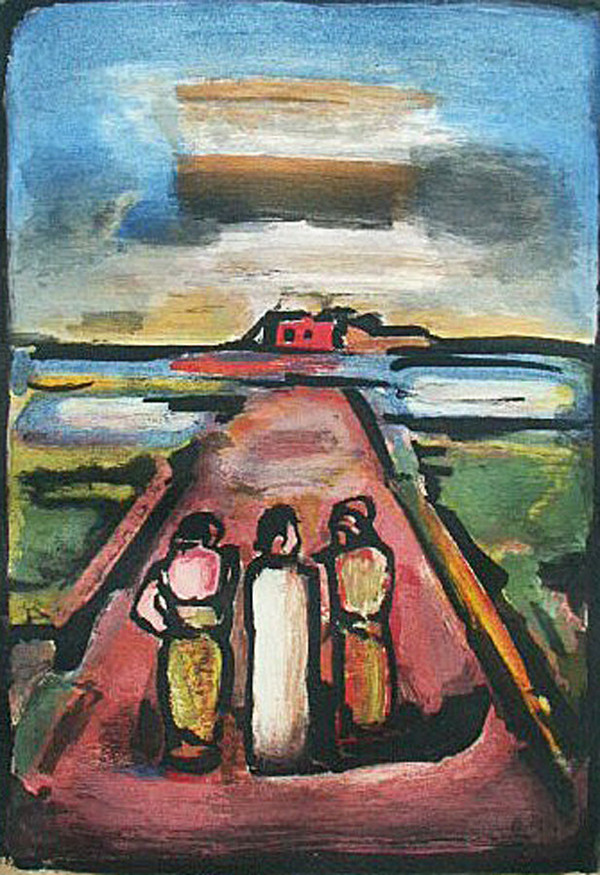
Scripture: Luke 24:13–35
On the day the tomb was found empty, two of Jesus’ disciples were walking in the wrong direction.
Literally. Jerusalem, where the women had brought their confusing report that morning, where the other disciples were still gathered, where every single thing that was about to matter in the story of the early church was going to happen, was behind them. They were walking seven miles the other way, to a town called Emmaus where not much was happening.
They weren’t just going for a walk. They were leaving.
They were leaving the movement. They were leaving the community. They were leaving whatever was left of their belief that Jesus had mattered. Luke puts it in the sad past tense:
“We had hoped that he was the one to redeem Israel.”
Had hoped. The hope is gone. They are walking away from something they are no longer sure they believe.
But here’s the encouraging part:: Jesus did not wait for them to come back.
He did not stand in Jerusalem with the others and demand their return. He did not send someone to chase them down.
He just showed up on the road they were walking.
And he walked beside them.
He Didn’t Explain It. He Just Asked a Question.
The first thing the risen Christ does after appearing to Cleopas and his companion is ask them a question: “What are you discussing as you walk along?”
Of course he knows. He lived it. He was at the center of every event they are about to retell.
But he asks anyway. And Luke tells us they stood still, looking sad. Then Cleopas, the only one named, basically says: are you the only person in Jerusalem who doesn’t know what happened?
Drawing them out, Jesus says, “What things?”
And then he listens to their entire story. Everything they had hoped. Everything that went wrong. The confusing report the women brought back from the tomb that morning, the report they clearly had not believed, because if they had, they would not be walking to Emmaus. He lets them speak the whole thing before he says one theological word.
This is the part American Christianity keeps forgetting.
The risen Christ, the one who has every right to interrupt, correct, rebuke, and straighten them out, lets them talk. He makes space for their grief. He does not flinch when they tell the story of his own death back to him wrong. He is not defensive about his own resurrection. He is not worried about being contradicted. He is a companion before he is anything else.
Much of what passes for Christian witness in this country is exactly the opposite of this.
We have become a people who speak first. We post first. We argue first. We quote a verse before we hear a sentence of someone’s actual life. We are so eager to be right that we cannot sit long enough with another human being to be useful. We confuse having the correct position with doing the work of love. And we wonder why the road away from us is getting more crowded.
Jesus on the Emmaus road is not a culture warrior. He is not marshalling an argument. He is not loading up a rebuttal. He is walking. He is asking. He is listening. And only after all of that does he open the scriptures.
We have the order reversed, and it shows.
Why People Are Actually Leaving
I have said some version of this from the pulpit before. I will say it more plainly here.
The research on why people are leaving the church in America keeps turning up an answer a lot of pastors do not want to hear. People are not, by and large, walking away because a skeptic convinced them the resurrection did not happen. Most of them still believe something. Many of them still pray. Some of them still miss what they left.
They are leaving because they felt unseen, unheard, or unwelcome in the community that was supposed to be home.
They are leaving because they watched their church trade the gospel for political identity and could no longer tell which one was driving the bus.
They are leaving because they brought a question and were handed a warning.
They are leaving because they came in discouraged and were given a fight.
They are leaving because the version of Christianity they encountered was, in its public posture, indistinguishable from a cable news panel, angry, defensive, obsessed with winning, allergic to nuance, quick to label the unlike-minded as enemies of God.
These are people who had hoped. And now they are walking to Emmaus.
The question Luke 24 is asking the church is not how do we get them back? The question Luke 24 is asking is who will walk beside them?
Those are not the same question, and confusing one for the other is part of how we got here.
The Guest Who Becomes Host
Look at what happens at the end of the journey. They arrive at Emmaus. The stranger acts as if he will keep going. Their hospitality is what opens the next moment. They say:
“Stay with us, for it is almost evening and the day is nearly over.”
They welcome him. And then, Luke tells us, as they sit down at the table, this stranger, this guest they have welcomed in, he takes the bread, blesses it, breaks it, and gives it.
The guest becomes the host.
In most of the New Testament, Jesus is welcomed as a stranger and turns out to be the Lord of the house. He is the one you let in because it was almost evening, and then you discover that he has been the real host of every meal you have ever eaten.
American Christianity, in many of its loudest forms, has become the opposite of this story. We have become the kind of house that interrogates strangers at the door. We want to know where you stand on five or six issues before you sit at the table. We want you to agree with us first, and then maybe we will break bread with you. We have made ourselves gatekeepers of a meal we do not own, bouncers at a house we did not build, turning away guests to whom Christ might very well have made himself known, if we had simply let them in.
Every time the church trades hospitality for suspicion, we risk missing the moment of recognition.
Hearts That Burn
After Jesus vanishes from their sight, they say to each other:
“Were not our hearts burning within us while he opened the scriptures to us?”
They say their hearts burned. Something happened underneath the level of debate. Something happened at the level of the soul. And that burning began before they knew who he was. It began while he was simply walking with them.
The contrast with how we have been taught to do Christianity in much of this country could not be sharper.
We have been trained, in much of the modern American church, to think of faith as a set of positions to defend. We have been told the gospel is a debate to win, a culture to reclaim, a nation to redeem at the ballot box. We have confused a political platform with a pulpit. We have treated the kingdom of God as if it depended on our ability to hold institutional power rather than on the willingness of the risen Christ to keep showing up on the road.
But the disciples on the Emmaus road did not become the first evangelists of the resurrection because they won an argument. They became witnesses because their hearts burned while they were walked with. And then, notice this, they got up that same hour and walked seven miles back in the dark to tell the others.
Resurrection faith does not sit still, and it does not sit above anyone. It moves. It moves toward people. To walk beside them.
A Loneliness Epidemic
We are living in what the former U.S. Surgeon General called a public health crisis of loneliness. Nearly half of American adults report measurable loneliness. Civic life has been collapsing for decades, the clubs, the leagues, the neighborhood associations, the casual third spaces where strangers became friends. Robert Putnam chronicled all of this more than twenty years ago and the trend line has only gotten worse. Churches were once, for better and worse, one of the last remaining places in American life where people who would otherwise never meet actually knew each other’s names.
Much of American Christianity has responded to this moment by arguing about politics.
At the exact moment in our history when the neighborhoods around our church buildings are full of people who are quietly starving for companionship, many congregations have chosen to double down on cultural grievance. We have turned pulpits into platforms for partisan talking points. We have handed our moral authority over to whichever political tribe made us feel most powerful. We have alienated the very neighbors Jesus would have us walk beside, and then wondered why they will not walk with us.
This is not a partisan critique. This is a theological one. This is what the Emmaus road judges. The risen Christ’s first recorded act after the resurrection in Luke’s telling is not to raise an army, install a Christian king, or reclaim a culture. It is to walk beside two broken-hearted strangers for seven miles and make space for their grief.
If that is the risen Christ’s posture, then that is our job.
The church that finally grasps this will not be the loudest church. It will almost certainly be smaller than the one American Christians imagined they were building. But it will be the church that looks, actually looks, like the one on the Emmaus road. And that will be more than enough.
Who Will You Walk With?
Lent is over. Easter has come. But the work of the risen Christ is not finished. He is still on the road. He is still walking beside people who are walking the wrong way. And the question he is asking his church in 2026, in America, in this moment is the same question he has always asked:
Will you come walk with me?
Will you walk with them.
Because every time we walk beside someone in love, every time we listen before speaking, every time we share bread and presence with someone whose hope has gone quiet, the risen Christ walks that road again. And sometimes, at an ordinary table, in the breaking of ordinary bread, eyes are opened. Hope turns around. And nobody has to walk alone anymore.
REFLECTION QUESTION
Who in your life is walking to Emmaus right now: discouraged, drifting, quietly leaving something they used to love? What would it look like this week to slow your pace and stay with them a little longer, asking honest questions and listening before you offer a word?
A PRAYER FOR THE ROAD
Risen Christ,
You did not wait in Jerusalem.
You walked out to meet them on the road they were using to leave.
Forgive us for building a Christianity you would not recognize on the Emmaus road — louder than your listening, prouder than your posture, more interested in winning than in walking.
Forgive us for the guests we have turned away from tables we do not own.
Forgive us for the questions we have answered with warnings.
Forgive us for mistaking a political tribe for your body.
Forgive us for confusing noise for faith.
Teach us how to walk beside the ones who are leaving — without agenda, without ambush, without needing them to be fixed before we love them.
Make us hospitable enough to welcome strangers, patient enough to let them speak, humble enough to let you be the host at our table.
Burn in our hearts again, Lord, and send us back into the dark to tell the others that you are still walking.
In the name of the risen Christ, who walks with us always — Amen.

 The Rest of the Sermon