
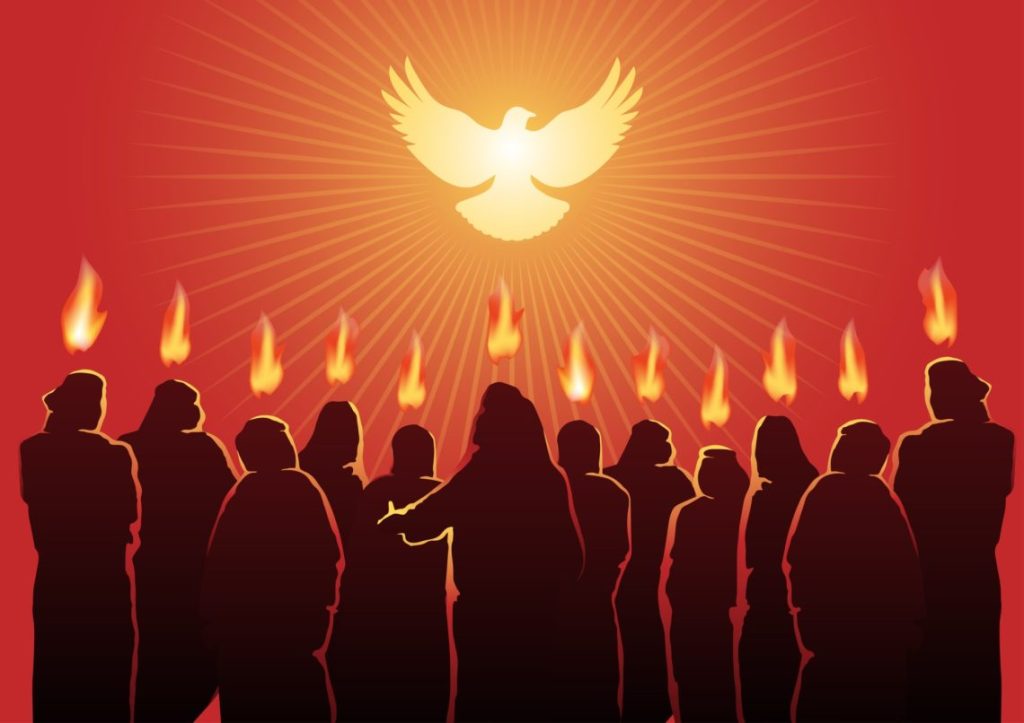
2 When the day of Pentecost had arrived, they were all together in one place.2 Suddenly a sound like that of a violent rushing wind came from heaven, and it filled the whole house where they were staying. 3 They saw tongues like flames of fire that separated and rested on each one of them. 4 Then they were all filled with the Holy Spirit and began to speak in different tongues,[a] as the Spirit enabled them. 5 Now there were Jews staying in Jerusalem, devout people from every nation under heaven. 6 When this sound occurred, a crowd came together and was confused because each one heard them speaking in his own language. – Acts 2:1–21
Taking It to the Streets
There’s a detail in the Pentecost story that’s easy to miss beneath all the dramatic stuff; the wind, the fire, the speaking in tongues.
It happened outside.
The disciples had been inside for weeks. Behind closed doors. Afraid. Confused. Trying to figure out what resurrection was supposed to mean now that Jesus was gone again. And then the Spirit showed up, and the first thing that happened was movement. The room opened. The church spilled into the street.
And suddenly people from all over the known world heard the story of Jesus in their own language.
Not some generic message full of religious jargon. Something they could actually understand. Something that sounded like home.
This is more important than we realize.
Pentecost Was Already Celebrated
Pentecost didn’t begin as a Christian celebration. Long before Acts 2, Jewish people were gathering in Jerusalem for the festival of Shavuot, fifty days after Passover. Originally it marked the first harvest of the season, but over time it also became connected to the giving of the Law at Mount Sinai.
And according to Jewish tradition, when God spoke at Sinai, the voice of God was heard in many languages — not just one. The idea was that God’s word was never meant for a tiny corner of humanity. It was meant for the whole world.
Luke knows exactly what he’s doing in Acts.
Fire at Sinai. Fire at Pentecost.
The voice of God at Sinai. The voices of ordinary people at Pentecost.
The Law written on stone. The Spirit written on human hearts.
This is not a random miracle story about strange spiritual experiences. It’s about God moving outward. Toward people. Toward differences. Toward the messy reality of human life.
The Spirit did not arrive to create a holy social club.
The Spirit arrived in the streets.
Babel and Pentecost
To understand Pentecost, you really have to go back to the Tower of Babel in Genesis 11.
Babel is often treated like a children’s story explaining why different languages exist. But underneath it is a deeper problem: human beings trying to build a world centered on themselves. “Let us make a name for ourselves,” they say.
And the result is fragmentation. Confusion. Division.
Language becomes a barrier instead of a bridge.
Pentecost doesn’t erase human difference. It doesn’t mold everybody into one culture or one voice. The miracle is that people understand each other without becoming identical to each other.
Parthians hear in Parthian. Egyptians hear in Egyptian. Romans hear in their own language.
Differences remains. Understanding becomes possible.
We live in a culture where people increasingly cannot hear each other at all.
We don’t just disagree anymore. We inhabit entirely different realities. Different news sources. Different fears. Different assumptions about what words even mean.
The church has not escaped this.
Too often we sound just as divided, suspicious, angry, and tribal as everyone else around us.
The Church Has a Language Problem
I say this as someone who has spent his whole life in the church: a lot of churches have forgotten how to speak to anyone outside themselves.
We’ve become fluent in insider language.
We know how to talk to people who already agree with us, already understand the vocabulary, already know when to stand and sit and sing. But we often struggle to speak in ways that connect with people beyond our walls.
And sometimes we’ve expected people to adapt to us before we were willing to meet them where they are.
But that’s not what happens in Acts 2.
The disciples don’t stand in the doorway yelling, “Come inside and learn our language.”
They go out.
And the people listening are not all the same. Luke lists region after region after region. Different cultures. Different backgrounds. Different experiences.
Yet somehow every person hears something life-giving in words they recognize.
That’s the miracle.
Not volume. Not performance. Connection.
“I Will Pour Out My Spirit on All People”
When Peter tries to explain what’s happening, he quotes the prophet Joel:
“Your sons and daughters will prophesy.
Your young men will see visions.
Your old men will dream dreams.”
And then Joel keeps going:
“Even on servants, both men and women, I will pour out my Spirit.”
In other words: the circle keeps widening.
The Spirit is not reserved for the important people. Not limited to the educated or the wealthy or the powerful. Pentecost tears through all the usual categories people use to decide who matters and who doesn’t.
Everybody in that room receives the Spirit.
Everybody is sent to speak.
That’s part of what makes the church’s history so painful sometimes. Because we have not always acted like we believe that.
There have been times when the church has treated certain voices as less trustworthy. Less welcome. Less worthy of being heard.
But Pentecost keeps pushing outward.
The Spirit refuses to stay contained inside the boundaries people try to build.
The Same Disciples
One of the things I love most about this story is that the people speaking boldly in Acts 2 are the exact same people who were terrified earlier in the story.
Nothing about them had been especially impressive.
Peter had denied Jesus. Thomas doubted. Most of them had run away at the crucifixion.
And yet these are the people God uses.
That really matters, because a lot of us think we have to be some kind of spiritual superstar before God can use us.
But Pentecost says otherwise.
The Spirit does not wait for perfect people.
The Spirit works through frightened people. Doubting people. Grieving people. People who are still figuring things out.
The miracle isn’t that the disciples suddenly became flawless.
The miracle is that fear stopped having the final word.
Speaking Someone’s Language
So here’s the question I keep coming back to this week:
Who in your life is waiting to hear good news in a language they can actually understand?
Not church language.
Not religious clichés.
Not culture-war talking points.
Their language.
What keeps them up at night? What are they carrying? What are they longing for? What wounds make them suspicious of church in the first place?
Because speaking someone’s language begins with listening.
Real listening. Not listening so you can argue better. Not listening so you can fix somebody. Listening because you genuinely want to understand another human being.
That’s what strikes me about Pentecost. The disciples don’t just become louder. They become understandable.
And that kind of understanding feels increasingly rare.
We live in a world that rewards outrage. Rewards certainty. Rewards quick judgments and instant reactions. Everything pushes us toward caricature instead of compassion.
But the church is supposed to be a place where people are heard before they are labeled.
That’s hard work. It requires humility. Patience. Curiosity.
It also requires giving up the comfort of only talking to people who already think like we do.
From the Locked Room to the Street
We began this series with frightened disciples hiding behind closed doors.
We end in the middle of the street.
Same people. Different posture.
That’s the movement of resurrection.
Fear slowly becoming courage.
Isolation becoming witness.
Closed doors becoming open ones.
And maybe that’s where some of us are right now, somewhere between the locked room and the street.
Still uncertain. Still cautious. Still carrying doubts.
That’s okay.
The disciples didn’t become brave overnight. Pentecost came after weeks of grief and confusion and waiting.
But eventually the doors opened.
Eventually the Spirit pushed them outward.
And maybe that’s still what the Spirit does best.
A Question to Ponder
Think of one person in your life who is disconnected from church, skeptical of it, hurt by it, indifferent to it, whatever the reason may be.
What language do they speak emotionally?
What matters to them?
What fears shape them?
What kind of hope would actually sound like good news to them?
And what would it look like to meet them there?
Closing Prayer
Spirit of God,
You met frightened people behind locked doors
and led them into the street.
You gave ordinary people the courage to speak
so their neighbors could hear something true and life-giving.
We confess how easy it is for us to stay comfortable —
to speak only to people who already understand us,
to stay inside familiar walls,
to mistake safety for faithfulness.
Teach us to listen well.
Teach us to love people enough to understand them.
Teach us how to speak with honesty and grace
in a world where people struggle to hear each other at all.
Open our doors.
Open our hearts.
And send us out again.
In the name of Christ, Amen.

 The Rest of the Sermon