
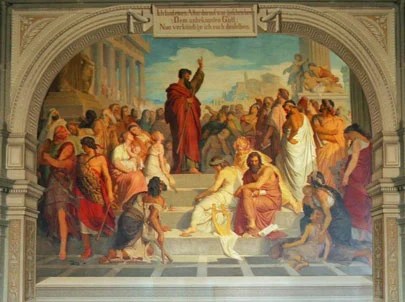
Paul Paid Attention
Paul had been walking around Athens for a few days, and according to Acts 17, he was provoked. That’s the word Luke uses. The city was full of idols, and it got under his skin.
Paul didn’t write off the Athenians as a lost cause and shake the dust from his feet.
He looked more carefully.
When he finally got to the Areopagus — the philosophical and civic council of Athens, one of the most important intellectual gathering places in the ancient world — he opened with an observation: “Athenians, I see that in every way you are very religious.”
He had walked through the city and seen something underneath the idols: hunger. The Athenians were extravagantly, almost frantically religious. They had an altar for every deity they could name and one more for any they might have missed. And that last altar dedicated to “an unknown god” was Paul’s way in.
“What you worship as unknown,” he said, “I am going to proclaim to you.”
He wasn’t there to condemn them. He was there to introduce them to someone they’d been reaching for without knowing his name.
The Idols We Actually Have
We tend to imagine idols as carved stone figures or golden calves, something we’d never fall for. But idols are rarely that obvious, and they’re almost never ugly.
The most powerful idols are beautiful. They’re good things that quietly become the thing we organize everything else around. They become the answer to the question: what holds my life together?
Paul’s list, if he walked through our lives today, would probably include some familiar names.
Work. Family. Security. Status. And the obvious one, politics.
When our political identity starts to feel more central and defining than our faith, that’s an altar. When we’re more disturbed by an election result than by the state of our own soul, that’s an altar. When we’re quicker to defend the sins of our political leaders than to follow the actual teachings of Jesus, we’ve built something, placed it at the center of our lives, and called it righteous.
The church is on that list too, which might surprise you. But people whose entire identity is wrapped up in a particular congregation, a particular tradition, a particular way of doing things, when something in that institution changes, they don’t grieve the loss of Jesus. They grieve the loss of the box they’d put Jesus in. Somewhere faith has fused with the institution until they became indistinguishable.
Even spiritual practices can get there. Your quiet time can become a performance. Your church attendance can become a way of feeling superior to the people who didn’t show up. The practices that are meant to connect you to God become the thing you’re proud of instead of the God they point toward.
Paul walked through Athens and saw altars everywhere. He would see the same thing walking through our lives. And he’d say what he said there: you are very religious. You are reaching for something. Now let me tell you what you’re actually reaching for.
The People the Church Gave Up On
Studies of religious life in America consistently show that even among people with no religious affiliation, most still believe in something beyond themselves, pray occasionally, and describe experiences they consider spiritual. They’ve left church. They haven’t left the longing.
You see it in the way people talk about “energy” or “the universe,” reaching for something personal but landing on impersonal language because they haven’t found a better word. You see it in the hunger for ritual, in yoga studios and farmers markets and concert experiences that people describe in almost sacred terms. You see it in the person who says, “I’m spiritual but not religious.”
What you hear underneath that phrase is this: I have this longing and I just don’t have a home for it yet.
Those are Paul’s Athenians. They didn’t leave because they stopped caring about transcendence. Most of them left because the church they encountered had already replaced transcendence with something else, certainty, tribalism, political theater, institutional self-preservation. They walked in looking for God and found a culture war. Can’t entirely blame them for leaving.
The truth is that much of American Christianity has spent the last few decades doing the opposite of what Paul did at the Areopagus. Paul went where people were. He engaged their culture, quoted their poets, and found the genuine longing underneath the misdirected worship. He didn’t demand they come to him. He didn’t make them clean up their theology before he’d talk to them. He walked into their world and said: you’re already looking, let me show you what you’re looking for.
Meanwhile, significant parts of the American church have become increasingly focused on reclaiming cultural dominance, winning elections, and drawing sharper lines around who’s in and who’s out. Jesus spent most of his ministry blurring those lines. He kept ending up at dinner with exactly the people the religious establishment had written off.
We might want to think about which model we’re actually following.
You’re Not the First One There
In John 14, Jesus promises his followers an Advocate, the Spirit of truth, who will be with them and in them. When Paul stood at the Areopagus, he wasn’t the only one working. The Spirit goes ahead. Into every conversation. Into every searching person. Into every life that hasn’t found the right name yet for what it’s longing for.
This is genuinely freeing: you are not responsible for manufacturing God’s presence in someone else’s life. God isn’t waiting for you to show up before he gets started. The Spirit has already been at work in every person you know, in their doubts, their losses, their searching, and yes, in their idols. Because idols are, at their root, evidence of longing. People don’t build altars to nothing. They build altars because something in them knows there’s something worth reaching for.
1 Peter 3:15 says to always be ready to give an answer for the hope you have, but do it with gentleness and respect. The text assumes people are already asking. Which means the life we live should raise questions that our words can then answer. We live in a way that makes people curious, and then we’re ready when they ask.
Paul didn’t have a perfect night at the Areopagus. Some sneered. Some wanted to hear more. A few believed. He planted a seed by finding the seed that was already there.
God is not far from any of us. Not from the Greek philosophers. Not from the spiritual-but-not-religious neighbor. Not from the person who has built their whole world around their career, or their kids, or their political identity, and who, underneath all of it, is still reaching.
He is not far. And we are not the first ones there. The Spirit has already been there.
Walk in. Recognize the altar. And say what Paul said: what you’re reaching for, I know him. He has a name.
REFLECTION
Where have you built an altar without realizing it, and what genuine longing is underneath it? And when was the last time you walked toward someone who was searching, instead of waiting for them to find their way to you?
CLOSING PRAYER
Lord, you know what we’ve put at the center. You know the good things we’ve leaned on too hard, the institutions we’ve fused our identity with, the political tribes we’ve defended more fiercely than your teachings, the practices we’ve turned into badges. Search us, and meet us there. Not with condemnation, but with the same patience you showed Athens.
Remind us that you were already at work in us before we knew your name, and that you’re already at work in the people we love who are still searching. Give us eyes to see the longing underneath the idols, in our own lives and in theirs. Give us the courage to name you when someone asks, and the wisdom to do it gently.
And keep drawing us back to the one thing that actually holds, not our politics, not our traditions, not our accomplishments, but you.
You are not far. Thank you for that.
Amen.


