
The most revolutionary community in human history had no strategy.
No branding. No five-year plan. No political allies. No capital campaign. No “growth hacks.” The early church, described in Acts 2, was a few hundred shell-shocked people in Jerusalem who had just watched their leader get executed and then inexplicably come back to life. They didn’t have a playbook. They had four practices.
And somehow, those four practices turned the Roman Empire upside down.
Meanwhile, the modern American church, flush with resources, connected to political power, armed with production budgets and podcast strategies, is shrinking. Fast.
Maybe we should read Acts 2 again.
WHAT LUKE ACTUALLY SAYS
Acts 2:42 is the most compressed ecclesiology in the New Testament. “Ecclesiology” is a fancy seminary word that just means the theology of what the church is supposed to be. Luke gives it to us in one verse:
They devoted themselves to the apostles’ teaching, to the fellowship, to the breaking of bread, and to prayer. — Acts 2:42
Four things. Teaching. Fellowship. Breaking bread. Prayer.
That’s it. That’s the whole blueprint.
The word translated “devoted” is the Greek word proskartereo. It means to persist in something, to adhere to it stubbornly, to give it constant attention, not because you feel like it every day, but because you’ve decided this is what shapes a life. It’s the word for a discipline, not a preference. A practice, not a vibe.
Notice what is conspicuously absent from this list.
There’s no mention of a building. No mention of a budget. No mention of political influence or cultural leverage or winning elections or protecting religious liberty. No mention of who’s in and who’s out. No mention of a preferred candidate or a policy platform or a voting bloc.
Just four things. And a community that would, within a few generations, change civilization.
THE FIRST DEVOTION: THE STORY
The early church was devoted to the apostles’ teaching, which, at that point, was not a printed text. There was no New Testament yet. What they had was living memory: people who had walked with Jesus, eaten with him, watched him die, and touched his scars after the resurrection. The teaching was the story.
They returned to it constantly. They told it and retold it. They let it interpret their lives rather than letting their lives interpret it.
Compare that to how Scripture often functions in American Christianity today. It gets quoted selectively to support conclusions we’ve already reached. Verses get yanked out of context and deployed like weapons in culture war arguments. Entire swaths of Jesus’s actual teaching — on wealth, on enemies, on power, on the poor — get quietly set aside because they’re inconvenient for our preferred politics.
The early church wasn’t doing that. They were letting the story of a crucified and risen Jesus reshape everything — their relationships, their economics, their sense of who mattered and who didn’t.
That’s a lot harder than posting a Bible verse on Instagram. Which is probably why we prefer the Instagram version.
THE SECOND DEVOTION: FELLOWSHIP
The word Luke uses for fellowship is koinonia. It gets translated as “fellowship,” which, in most churches, has come to mean coffee hour after the service, or maybe a potluck if you’re really committed.
That is not what koinonia means.
Koinonia means participation. Shared life. Mutual belonging. It means your joy actually matters to me as a lived reality. Your struggle affects me. Your need becomes my concern. We are tangled up in each other’s lives.
The early church didn’t “attend” church. They lived church. Every day. With people who were very different from them, Jews and Gentiles, wealthy and poor, slaves and free people. The resurrection had created a new family, and this family ate together, prayed together, and held each other’s lives.
Sociologists today describe our cultural moment with a phrase: “bowling alone.” We have more digital connections than any generation in history, and less actual community. Loneliness is being called a public health crisis. People are isolated in their homes, consuming content designed to confirm their existing beliefs, and wondering why they feel hollow.
Into that emptiness, Acts 2 offers something almost scandalous: people who actually knew each other. Who showed up. Who shared meals and resources and life.
The church could be that. In many places, it still is. But it requires something the consumerist model of the American church doesn’t provide: inconvenience. Genuine community is inconvenient. It demands your time, your attention, your willingness to be known, not just to be seen.
We’ve gotten very good at being seen. We’re not nearly as good at being known.
THE THIRD DEVOTION: THE TABLE
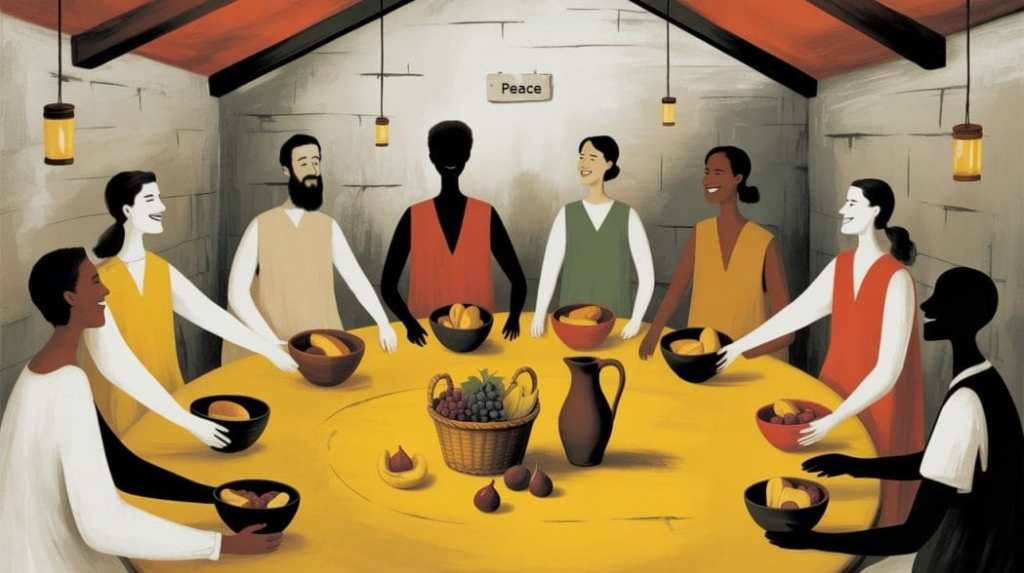
The breaking of bread included the Lord’s Supper, yes. But in the early church, there was no sharp line between the sacred meal and the shared meal. The table was just the table. They ate in each other’s homes. They fed each other. They remembered Jesus not only in formal worship but in ordinary kitchens, around ordinary food, in the middle of ordinary evenings.
Every meal was a resurrection meal. Every shared loaf was a reminder that death had not won and fear no longer had to run the show.
There’s something quietly radical about this that we’ve mostly domesticated. We’ve turned communion into a ritual one Sunday a month, and involves tiny crackers in a tray. Which is fine because liturgy matters, and the sacrament is real. But we’ve lost the sense that the entire table, any table, is sacred. That when we sit down with someone and share food, we are doing something holy.
Jesus ate with people everyone else refused to eat with. He ate with tax collectors, prostitutes, lepers, and Samaritans. In the ancient world, the dinner table was one of the sharpest social boundaries that existed. You ate with your own people. Jesus kept crashing those boundaries.
The American church, by and large, has rebuilt them. We eat with people who vote like us, believe like us, look like us, earn like us. We’ve turned the table of fellowship into a gated community. And then we wonder why the world finds us uninteresting.
THE FOURTH DEVOTION: PRAYER
Luke mentions prayer last, but that doesn’t make it least. In fact, prayer might be the most countercultural thing on this list.
Luke doesn’t specify the form — corporate, private, liturgical, spontaneous. He just says they were devoted to it. And crucially, he doesn’t treat prayer as the warm-up exercise before the real work begins.
Prayer is the work.
Because prayer is the practice that keeps a community oriented toward God instead of toward its own strength, its own strategies, its own ego. It’s the discipline that reminds us we are not, in fact, in control, and that this is actually a good thing.
In a cultural moment defined by the relentless need to perform, to produce, to project certainty and strength, prayer is the act of saying: I’m not enough on my own, and I know it, and I’m okay with that.
American Christianity has largely abandoned that posture. We have confused faith with confidence, prayer with lobbying God for outcomes, and trust with optimism. We’ve turned the church into a power center rather than a praying community. We’ve traded dependence on God for access to earthly power, and we’ve gotten both the access and the corruption that comes with it, and we’ve lost the plot entirely.
WHAT LUKE SAYS HAPPENED NEXT
After describing these four devotions, Luke says something worth paying attention to: Everyone was filled with awe, and many wonders and signs were being performed through the apostles. — Acts 2:43
Awe. Not applause. Not metrics. Not a fundraising campaign.
Awe is not something you can create. You cannot put it on the church calendar or optimize it with better lighting. Awe happens when something larger than your expectations breaks into ordinary life.
Luke wants us to notice that awe was not the goal. It was the result. They weren’t chasing spiritual experiences. They were simply living faithfully together, and God’s presence became visible in them.
That’s a deeply inconvenient sentence for a church culture that has become expert at manufacturing experiences. We know how to design a moment that feels powerful. Lighting, music, pacing, a strong closing illustration, we’ve got it down to a science. And none of that is inherently wrong.
But the awe Luke describes is different. It rises when people see a community living in a way that only makes sense if Jesus is actually alive. When forgiveness happens where resentment should live. When generosity shows up where scarcity should rule. When people from different walks of life, people who, outside of this community, would have nothing in common, actually love each other.
That kind of awe cannot be produced. It can only be witnessed.
THE PART THAT MAKES US UNCOMFORTABLE
Then Luke says this: All the believers were together and held all things in common. They sold their possessions and property and distributed the proceeds to all, as any had need. — Acts 2:44–45
I know. I can already hear the nervous laughter.
Before anyone reaches for the word “socialism,” the early church wasn’t implementing an economic ideology. No one was forced into anything. There was no centralized redistribution scheme. What was happening was something far more interesting and far more threatening to our assumptions.
They believed the resurrection had changed the meaning of security itself.
If death had been defeated, actually defeated, then accumulating wealth to protect yourself from an uncertain future no longer made ultimate sense. The old logic of self-preservation was based on scarcity and fear. Resurrection said: There is enough. There is more than enough. And the person next to you matters more than your comfort.
Their possessions stopped being walls of protection and became tools of love.
Now. Compare that to contemporary American Christianity, where prosperity theology has told millions of people that God rewards faith with financial success. Where entire church budgets are structured around buildings and programs, while the hungry go unfed. Where we will fight bitterly for tax exemptions and political access and religious liberty protections, but the actual poor, the ones Jesus talked about constantly, relentlessly, without apology, remain a footnote.
The early church had no political power. No tax status to protect. No cultural dominance to preserve. And they shared everything. Not because they were legally required to. Because they actually believed the resurrection had changed things.
The question that puts us on the spot is this: Do we?
THE LAST SENTENCE OF THE PASSAGE
Luke closes with this: And the Lord added to their number daily those who were being saved. — Acts 2:47
Notice who the subject is. Not the apostles. Not the program. Not the strategy.
The Lord.
Growth was not their achievement. It was God’s. Their responsibility was their devotion. Show up to the teaching. Share life together. Come to the table. Pray. Live as if the resurrection actually happened.
And God did what only God can do.
The church does not need to reinvent itself to be faithful. We don’t need better branding. We don’t need a seat at the political table. We don’t need to be louder, trendier, or more impressive.
We need devotion.
Devotion to the story that forms us. Devotion to a community that shares life. Devotion to the table that reminds us who we are. Devotion to the prayer that keeps us rooted in God rather than in our own ambitions.
Because here’s what I think we forget: the church isn’t supposed to run the world. It’s supposed to be a living demonstration that the world has already been redeemed, and that there’s a better way to be human.
When we forget that, we reach for power. And we become exactly the kind of institution that Jesus spent most of his ministry pushing back against.
When we remember it, we become the kind of community that makes people stop and ask: What is it about these people?
That question is the beginning of everything.
REFLECTION
Acts 2 describes a community devoted to four things: teaching, fellowship, the shared table, and prayer. Which of those four feels most absent from your life right now — and what would it actually cost you to take it seriously?
A CLOSING PRAYER
Lord, we confess that we have made the church into a lot of things you never asked for.
We’ve made it a political operation. A social club. A branding exercise. A comfort station.
And in doing so, we’ve mostly just made it smaller — in influence, in integrity, and in your presence.
Forgive us for chasing relevance when you asked for devotion.
Forgive us for pursuing power when you offered something better: a table, a story, a community, and a God who actually shows up.
Form us into something that looks less like a religious institution protecting its interests and more like the people who turned the world upside down because they actually believed a dead man had walked out of a tomb.
Teach us again what devotion looks like.
Teach us to show up. To share. To pray.
And do what only you can do with communities that actually mean it.
Amen.

 The Rest of the Sermon