
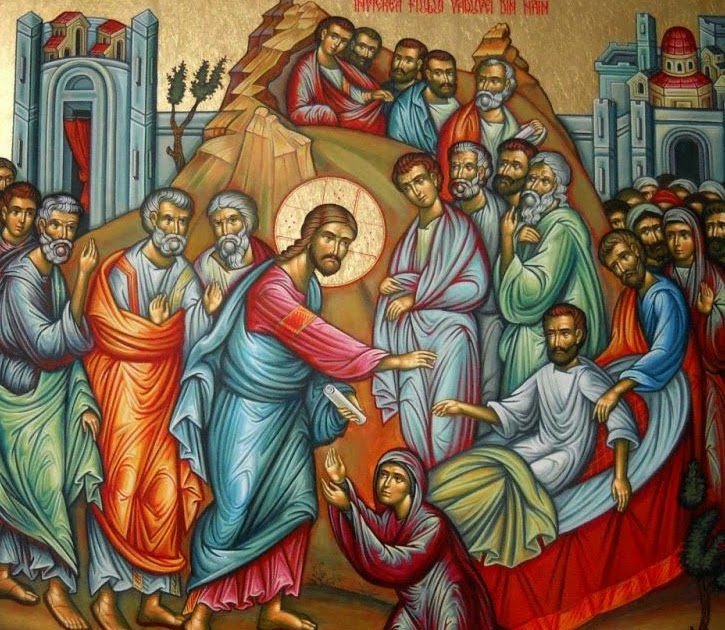
When the Lord saw her, his heart went out to her and he said, “Don’t cry.” – Luke 7:13
The healing stories in the Gospels tend to follow a pattern we’ve come to expect. Someone seeks Jesus out. They push through crowds, send messengers, fall at his feet, or shout from across the street. There’s a request. A conversation. Often a reference to faith. And then Jesus responds.
The story of the widow of Nain breaks that pattern completely.
She doesn’t ask for anything. She doesn’t know Jesus is nearby. She’s in the middle of the worst day of her life; walking behind the body of her only son and she’s simply surviving the moment. There is no petition. No declaration of faith. No “if you are willing, you can heal him.”
Just grief, a road, and a crowd that had somewhere else to be.
And then Luke says: “When the Lord saw her, his heart went out to her.”
He didn’t wait to be asked.
What This Story Is Actually About
We tend to rush to the miracle in this passage, and I understand why. A dead man sits up and starts talking. That’s hard to compete with. But Luke buries the real headline in a single line: “Jesus gave him back to his mother.”
The miracle was personal. It was aimed at a specific person’s individual pain. The crowd got a miracle. The woman got her son back.
In the first century, a widow who had also lost her only son wasn’t just grieving, she was facing genuine economic and social catastrophe. There were no safety nets. A husband provided security. An adult son could continue that protection after a husband’s death. With both gone, this woman’s future had just become frighteningly uncertain. She was walking toward a burial and, very likely, toward a life of poverty and dependence.
Jesus saw all of that. Not just the funeral. Not just the tears. The whole weight of what this moment meant for her life.
The Greek word Luke uses for Jesus’s response, usually translated “moved with compassion”, describes something visceral. It’s felt in the gut. This is not Jesus politely noting that someone is having a hard time. This is Jesus being genuinely affected by her pain.
Before the miracle, before the words to the dead man, Jesus speaks to the woman. “Don’t cry.” Not as a command to suppress grief, but as the beginning of his movement toward her. He’s addressing her before the problem. He sees the person before he deals the situation.
That sequence is more important than we usually notice.
The Church and the Art of Not Seeing
The crowd in Nain was present. They were walking right beside this woman. They were literally part of the funeral procession. And Luke tells us Jesus saw her, as though no one else had.
The crowd saw an event. Jesus saw a person.
The crowd saw a funeral. Jesus saw a mother.
The crowd saw a dead man. Jesus saw a woman’s grief.
There is a version of church that is very good at showing up for events and very bad at seeing people. We organize well. We execute programs. We fill seats and produce worship services. We’re often quite good at the institutional machinery of religion.
And we walk right past the grieving widow every single week.
I’m not talking about intentional cruelty. Most church people are not cruel. I’m talking about something more insidious: selective visibility. We see the people who fit our story; the ones who look like us, who share our politics, who are in a season of life that makes sense to us. And we don’t see, or don’t choose to see, the people who don’t.
In the current climate of American Christianity, this failure has taken on a particular shape. The loudest voices in the church are not talking about the widow of Nain. They’re talking about power. About cultural dominance. About reclaiming something they feel they’ve lost. The energy that might have gone toward seeing the suffering people in our communities has been redirected toward winning; winning elections, winning culture wars, winning arguments on social media.
Jesus walked toward a funeral procession he had no obligation to.
Much of the American church is walking in a very different direction right now.
When Suffering Becomes a Problem to Manage
Luke tells us Jesus spoke to the woman first: “Don’t cry.” Then he touched the bier and spoke to the dead man.
That order was intentional. Her pain came first.
One of the things the church has historically been terrible at is sitting with people in pain without immediately trying to fix them, explain them, or give them a reason for why this had to happen. We are profoundly uncomfortable with unanswered suffering. So we hand people platitudes. “God needed another angel.” “Everything happens for a reason.” “God won’t give you more than you can handle”, which, for the record, is not actually in the Bible.
We do this because grief is awkward and silence is uncomfortable and we feel responsible for producing some kind of resolution. A grieving person who leaves church still grieving feels like a failure on our part.
But Jesus never asks the widow why this happened. He doesn’t offer an explanation. He doesn’t suggest this is part of a plan she just needs to trust. He sees her suffering, is moved by it, and acts.
Notice he doesn’t say: “Your faith has made this possible.” He just does it. Because the point isn’t a lesson. The point is her. Her pain. Her son. Her future.
The church that actually follows Jesus will become fluent in presence before it becomes fluent in answers. It will learn to sit with people in the wreckage before it hands them a blueprint for rebuilding.
Most of us are not wired this way, and most of our institutional churches are not structured this way. We are oriented toward programs, services, and outputs. We are not naturally oriented toward the slow, inefficient, often invisible work of genuinely seeing people.
That has to change. And it won’t change by accident.
Compassion Is Not a Feeling. It’s a Practice.
The Greek word for Jesus’s gut-level response , splagchnizomai, appears in a handful of places in the Gospels. Jesus uses it in the parable of the prodigal son, when the father sees his wayward child returning and “is moved with compassion” and runs to meet him. He uses it in the parable of the Good Samaritan, when the Samaritan, a figure his Jewish audience would have found genuinely uncomfortable, sees the beaten man on the road and responds.
In every case, the compassion doesn’t stay inside the person who feels it. It moves towards another.
The father runs. The Samaritan binds wounds and pays for lodging. Jesus touches a bier and raises a dead man. The feeling becomes action because that’s what compassion is. It’s not an emotion you have about someone. It’s an orientation toward someone that changes what you do.
This is precisely the gap between what the American church claims to be and what it often is. We have a lot of feelings about suffering. But the splagchnizomai, the gut-level response that actually moves us toward the person, is frequently absent.
Instead, we have a church culture that is increasingly oriented toward self-protection. Protect the institution. Protect the brand. Protect the political alignment. Protect the demographic. If welcoming certain people might complicate those things, the compassion tends to stop short of action.
Jesus didn’t protect his reputation by stopping a funeral procession in a small town to raise a dead man. The crowd thought he was a prophet. He didn’t seem to care what the crowd thought. He cared about the woman.
The question for us is whether our compassion has feet. Whether it moves. Whether it changes our behavior, our priorities, our calendar, our budget, our willingness to be inconvenienced.
A compassion that doesn’t move isn’t compassion. It’s sentiment. And the world has plenty of that.
The Uncomfortable Part
The widow of Nain was an outsider to Jesus’s group. She wasn’t a follower. She didn’t know who he was. She hadn’t asked for his help. She was, essentially, a stranger on the road.
And he stopped everything for her.
The people we’re most likely to see are the people who are already inside our circles. Our families. Our congregations. Our political parties. Our demographic groups. That’s just how perception works.
But Jesus consistently, almost aggressively, saw people who were outside those circles. The Samaritan woman. The Roman centurion’s servant. Lepers. Tax collectors. People who were socially invisible, religiously excluded, economically marginalized.
He didn’t wait for them to get themselves in order first. He didn’t wait for them to believe correctly or live correctly or smell correctly. He saw them and moved toward them.
The American church’s current obsession with cultural power and political influence is, among other things, a profound failure of this pattern. It is a church that has decided to move toward the centers of power rather than toward the edges of society where Jesus consistently went. It is a church that has mistaken influence for faithfulness.
Those are not the same thing.
Faithfulness, at its most basic, looks like a man stopping a funeral procession because he saw a grieving woman and couldn’t walk past her.
A Question To Sit With
Who is in front of you this week that you’ve been seeing without actually seeing? The one you’ve been moving past because stopping would cost something; time, comfort, the efficient progression of your day. Jesus didn’t have a ministry plan for Nain. The widow wasn’t on his itinerary. She was just there, grieving, and he saw her. Who’s just there?
What Does It Mean?
This sermon came out of Luke 7, but it’s really about a question the text keeps asking: what does it mean for the church to see people the way Jesus saw people?
I don’t think the answer is another program. I don’t think it’s a new initiative or a vision statement or a community outreach event on the calendar. Those things aren’t bad, but they can become the church’s version of the Nain crowd, present at the procession without actually seeing who’s in it.
I think it starts with individual people deciding to look up. To slow down. To let someone else’s pain actually affect them. To stop performing empathy and start practicing attention.
The miracle in Nain is extraordinary. But Jesus stopped in the road because a grieving woman’s tears mattered to him.
We have to be willing to stop too.
A Closing Prayer
God, we confess that we’ve gotten very good at being present without actually seeing anyone.
We show up. We participate. We go through the motions of community while the people next to us carry grief we’ve never asked about.
Give us the kind of attention Jesus had. The kind that notices the person before it notices the event. The kind that is moved — actually moved, in the gut — by someone else’s pain.
And then give us the courage to do something about it.
We don’t always have miracles to offer. But we have presence. We have time. We have the ability to stop, to look someone in the eye, and to say: I see you.
Let that be enough to start.
Amen.

 The Rest of the Sermon